Wellcome Collection homepage
  • Visit us
  • What’s on
  • Stories
  • Collections
  • Get involved
  • About us
Sign in to your library account
Search for anything
Library account
Take me back to the item page

Punjab.

Date:
1908
Catalogue details

Licence: In copyright

Credit: Punjab. Source: Wellcome Collection.

  • Cover
  • Title Page
  • Table of Contents
  • Index
  • Cover
    418/486 (page 386)
    Previous page
    Next page
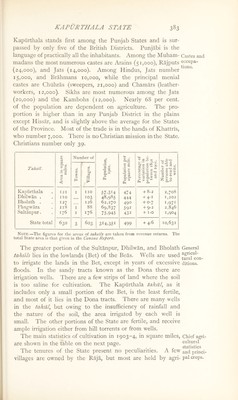
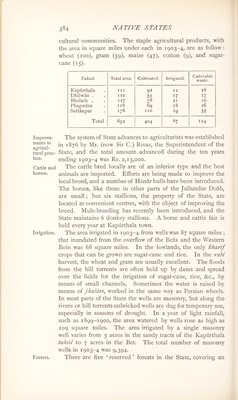
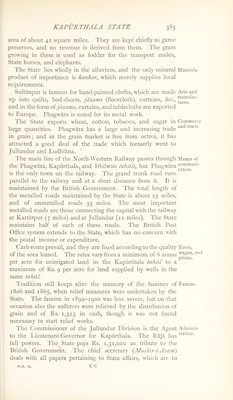
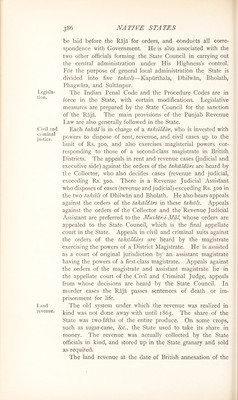
    Legisla- tion. Civil find criminal justice. Land revenue. be laid before the Raja for orders, and conducts all corre- spondence with Government. He is also associated with the two other officials forming the State Council in carrying out the central administration under His Highness’s control. For the purpose of general local administration the State is divided into five tahsils—Kaptirthala, Dhilwan, Bholath, Phagwara, and Sultanpur. The Indian Penal Code and the Procedure Codes are in force in the State, with certain modifications. Legislative measures are prepared by the State Council for the sanction of the Raja. The main provisions of the Punjab Revenue Law are also generally followed in the State. Each tahsll is in charge of a tahsilddr^ who is invested with powers to dispose of rent, revenue, and civil cases up to the limit of Rs. 300, and also exercises magisterial powers cor- responding to those of a second-class magistrate in British Districts. The appeals in rent and revenue cases (judicial and executive side) against the orders of the tahsllddrs are heard by the Collector, who also decides cases (revenue and judicial, exceeding Rs. 300. There is a Revenue Judicial Assistant who disposes of cases (revenue and judicial) exceeding Rs. 300 in the two tahsils of Dhilwan and Bholath. He also hears appeals against the orders of the tahsllddrs in these tahsils. Appeals against the orders of the Collector and the Revenue Judicial Assistant are preferred to the Mushlr-i-Mdl^ whose orders are appealed to the State Council, which is the final appellate court in the State. Appeals in civil and criminal suits against the orders of the tahsllddrs are heard by the magistrate exercising the powers of a District Magistrate. He is assisted as a court of original jurisdiction by an assistant magistrate having the powders of a first-class magistrate. Appeals against the orders of the magistrate and assistant magistrate lie in the appellate court of the Civil and Criminal Judge, appeals from wffiose decisions are heard by the State Council. In murder cases the Raja passes sentences of death or im- prisonment for life. The old system under which the revenue was realized in kind was not done away with until 1865. The share of the State was two-fifths of the entire produce. On some crops, such as sugar-cane, &c., the State used to take its share in money. The revenue was actually collected by the State officials in kind, and stored up in the State granary and sold as required. The land revenue at the date of British annexation of the
    page 383
    415
    page 384
    416
    page 385
    417
    page 386
    418
    page 387
    419
    page 388
    420
    Previous page
    Next page
    Wellcome Collection

    183 Euston Road
    London NW1 2BE

    +44 (0)20 7611 2222
    info@wellcomecollection.org

    • Getting here

    Today’s opening times

    • Galleries
      10:00 – 18:00
    • Library
      closed
    • Café
      10:00 – 18:00
    • Shop
      10:00 – 18:00

    Opening times

    Our building has:

    • Step free access
    • Hearing loops

    Accessibility

    • Visit us
    • What’s on
    • Stories
    • Collections
    • Get involved
    • About us
    • Contact us
    • Jobs
    • Media office
    • Developers
    • Privacy and terms
    • Cookie policy
    • Manage cookies
    • Modern slavery statement
    TikTok
    Facebook
    Instagram
    YouTube

    Except where otherwise noted, content on this site is licensed under a Creative Commons Attribution 4.0 International Licence