Wellcome Collection homepage
  • Visit us
  • What’s on
  • Stories
  • Collections
  • Get involved
  • About us
Sign in to your library account
Search for anything
Library account
Take me back to the item page

Punjab.

Date:
1908
Catalogue details

Licence: In copyright

Credit: Punjab. Source: Wellcome Collection.

  • Cover
  • Title Page
  • Table of Contents
  • Index
  • Cover
    420/486 (page 388)
    Previous page
    Next page
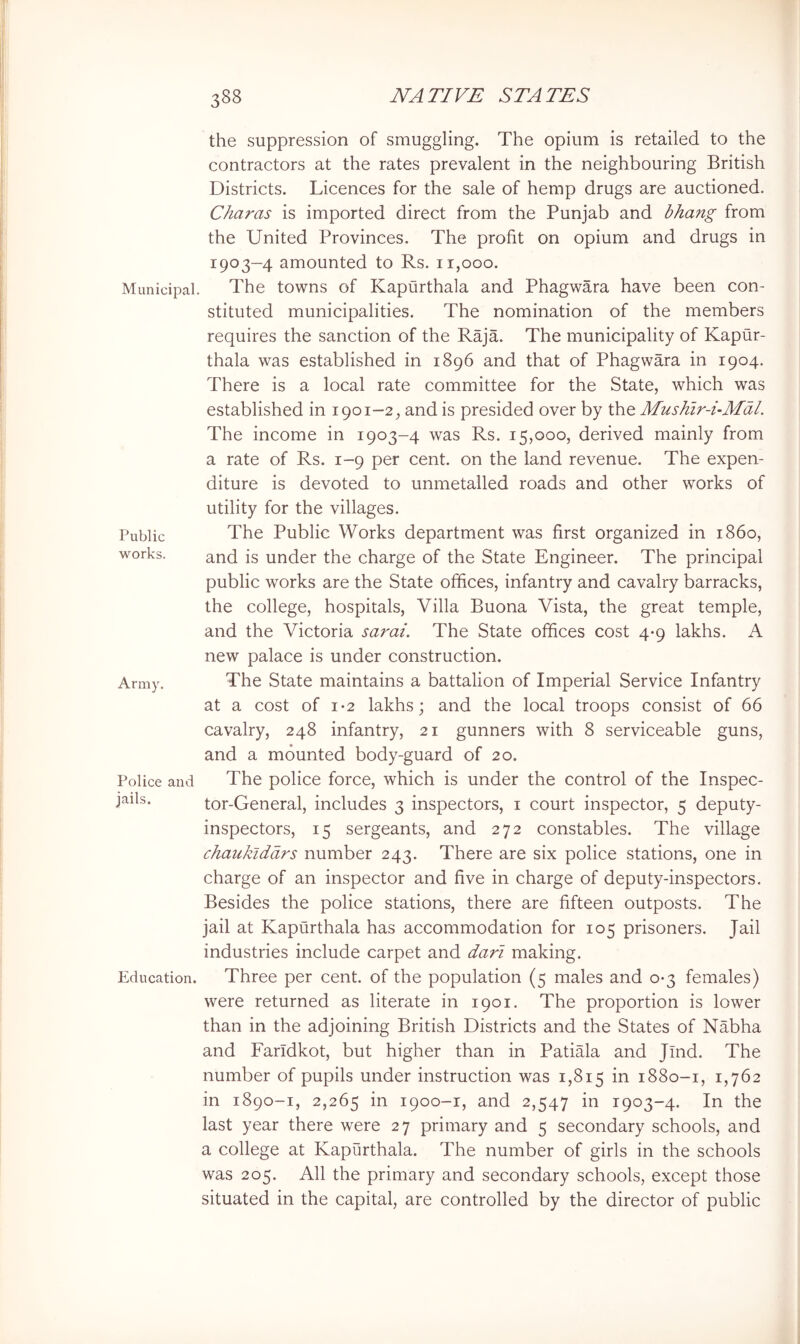
    Municipal. Public works. Army. Police and jails. Education. the suppression of smuggling. The opium is retailed to the contractors at the rates prevalent in the neighbouring British Districts. Licences for the sale of hemp drugs are auctioned. Charas is imported direct from the Punjab and bhang from the United Provinces. The profit on opium and drugs in 1903—4 amounted to Rs. 11,000. The towns of Kapurthala and Phagwara have been con- stituted municipalities. The nomination of the members requires the sanction of the Raja. The municipality of Kapur- thala was established in 1896 and that of Phagwara in 1904. There is a local rate committee for the State, which was established in 1901-2, and is presided over by the Mushir-i-Mdl. The income in 1903-4 was Rs. 15,000, derived mainly from a rate of Rs. 1-9 per cent, on the land revenue. The expen- diture is devoted to unmetalled roads and other works of utility for the villages. The Public Works department was first organized in i860, and is under the charge of the State Engineer. The principal public works are the State offices, infantry and cavalry barracks, the college, hospitals. Villa Buona Vista, the great temple, and the Victoria sarai. The State offices cost 4*9 lakhs. A new palace is under construction. The State maintains a battalion of Imperial Service Infantry at a cost of 1*2 lakhs; and the local troops consist of 66 cavalry, 248 infantry, 21 gunners with 8 serviceable guns, and a mounted body-guard of 20. The police force, which is under the control of the Inspec- tor-General, includes 3 inspectors, i court inspector, 5 deputy- inspectors, 15 sergeants, and 272 constables. The village chaukiddrs number 243. There are six police stations, one in charge of an inspector and five in charge of deputy-inspectors. Besides the police stations, there are fifteen outposts. The jail at Kapurthala has accommodation for 105 prisoners. Jail industries include carpet and dari making. Three per cent, of the population (5 males and 0*3 females) were returned as literate in 1901. The proportion is lower than in the adjoining British Districts and the States of Nabha and Faridkot, but higher than in Patiala and Jind. The number of pupils under instruction was 1,815 1880-1, 1,762 in 1890-1, 2,265 1900-1, and 2,547 in 1903-4. In the last year there were 27 primary and 5 secondary schools, and a college at Kapurthala. The number of girls in the schools was 205. All the primary and secondary schools, except those situated in the capital, are controlled by the director of public
    page 383
    415
    page 384
    416
    page 385
    417
    page 386
    418
    page 387
    419
    page 388
    420
    Previous page
    Next page
    Wellcome Collection

    183 Euston Road
    London NW1 2BE

    +44 (0)20 7611 2222
    info@wellcomecollection.org

    • Getting here

    Today’s opening times

    • Galleries
      10:00 – 18:00
    • Library
      10:00 – 16:00
    • Café
      10:00 – 18:00
    • Shop
      10:00 – 18:00

    Opening times

    Our building has:

    • Step free access
    • Hearing loops

    Accessibility

    • Visit us
    • What’s on
    • Stories
    • Collections
    • Get involved
    • About us
    • Contact us
    • Jobs
    • Media office
    • Developers
    • Privacy and terms
    • Cookie policy
    • Manage cookies
    • Modern slavery statement
    TikTok
    Facebook
    Instagram
    YouTube

    Except where otherwise noted, content on this site is licensed under a Creative Commons Attribution 4.0 International Licence