Wellcome Collection homepage
  • Visit us
  • What’s on
  • Stories
  • Collections
  • Get involved
  • About us
Sign in to your library account
Search for anything
Library account
Take me back to the item page

Punjab.

Date:
1908
Catalogue details

Licence: In copyright

Credit: Punjab. Source: Wellcome Collection.

  • Cover
  • Title Page
  • Table of Contents
  • Index
  • Cover
    425/486 (page 393)
    Previous page
    Next page
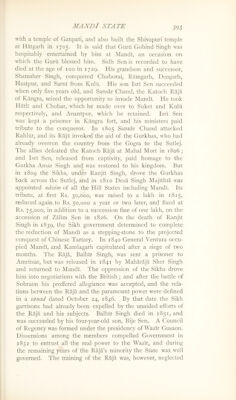
    with a temple of Ganpati, and also built the Shivapuri temple at Hatgarh in 1705. It is said that Guru Gobind Singh was hospitably entertained by him at MandT, an occasion on which the Guru blessed him. Sidh Sen is recorded to have died at the age of 100 in 1729. His grandson and successor, Shamsher Singh, conquered Chuborai, Ramgarh, Deogarh, Hastpur, and SarnI from Kulu. His son IsrI Sen succeeded when only five years old, and Sansar Chand, the Katoch Raja of Kangra, seized the opportunity to invade MandL He took Hatli and Chohar, which he made over to Suket and Kulu respectively, and Anantpur, which he retained. Isri Sen was kept a prisoner in Kangra fort, and his ministers paid tribute to the conqueror. In 1805 Sansar Chand attacked Rahliir, and its Raja invoked the aid of the Gurkhas, who had already overrun the country from the Gogra to the Sutlej. The allies defeated the Katoch Raja at Mahal Mori in 1806; and Isri Sen, released from captivity, paid homage to the Gurkha Amar Singh and was restored to his kingdom. But in 1809 the Sikhs, under Ranjit Singh, drove the Gurkhas back across the Sutlej, and in 1810 Desa Singh Majithia was appointed ndzhn of all the Hill States including Mandl. Its tribute, at first Rs. 30,000, was raised to a lakh in 1815, reduced again to Rs. 50,000 a year or two later, and fixed at Rs. 75,000, in addition to a succession fine of one lakh, on the accession of Zalim Sen in 1826. On the death of Ranjit Singh in 1839, the Sikh government determined to complete the reduction of Mandl as a stepping-stone to the projected conquest of Chinese Tartary. In 1840 General Ventura occu- pied Mandl, and Kamlagarh capitulated after a siege of two months. The Raja, Balbir Singh, was sent a prisoner to Amritsar, but was released in 1841 by Maharaja Sher Singh and returned to Mandl. The oppression of the Sikhs drove him into negotiations with the British; and after the battle of Sobraon his proffered allegiance was accepted, and the rela- tions between the Raja and the paramount power were defined in a sanad dated October 24, 1846. By that date the Sikh garrisons had already been expelled by the unaided efforts of the Raja and his subjects. Balbir Singh died in 1851, and was succeeded by his four-year-old son, Bije Sen. A Council of Regency was formed under the presidency of Wazir Gusaon. Dissensions among the members compelled Government in 1852 to entrust all the real power to the Wazir, and during the remaining years of the Raja’s minority the State was well governed. The training of the Raja was, however, neglected
    page 389
    421
    page 390
    422
    page 391
    423
    page 392
    424
    page 393
    425
    page 394
    426
    Previous page
    Next page
    Wellcome Collection

    183 Euston Road
    London NW1 2BE

    +44 (0)20 7611 2222
    info@wellcomecollection.org

    • Getting here

    Today’s opening times

    • Galleries
      10:00 – 18:00
    • Library
      10:00 – 18:00
    • Café
      10:00 – 18:00
    • Shop
      10:00 – 18:00

    Opening times

    Our building has:

    • Step free access
    • Hearing loops

    Accessibility

    • Visit us
    • What’s on
    • Stories
    • Collections
    • Get involved
    • About us
    • Contact us
    • Jobs
    • Media office
    • Developers
    • Privacy and terms
    • Cookie policy
    • Manage cookies
    • Modern slavery statement
    TikTok
    Facebook
    Instagram
    YouTube

    Except where otherwise noted, content on this site is licensed under a Creative Commons Attribution 4.0 International Licence