Wellcome Collection homepage
  • Visit us
  • What’s on
  • Stories
  • Collections
  • Get involved
  • About us
Sign in to your library account
Search for anything
Library account
Take me back to the item page

Punjab.

Date:
1908
Catalogue details

Licence: In copyright

Credit: Punjab. Source: Wellcome Collection.

  • Cover
  • Title Page
  • Table of Contents
  • Index
  • Cover
    46/486 (page 14)
    Previous page
    Next page
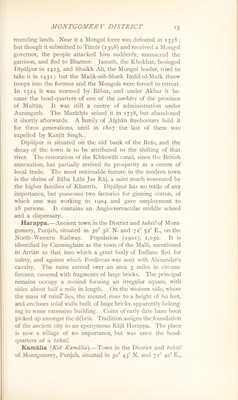
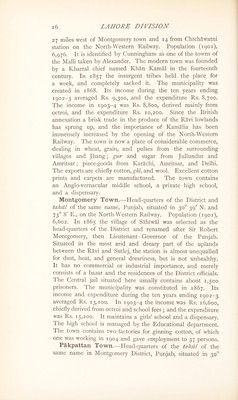
    with an area of 984 square miles. Its south-east border rests on the Sutlej. The population in 1901 was i79j735) compared with 180,455 in 1891. It contains 458 villages, including Dipalpur (population, 3,811), the head-quarters, which is a place of historical importance. The land revenue and cesses amounted in 1903-4 to Rs. 2,73,000. The whole of the tahsll lies in the lowlands between the central plateau of the Bari Doab and the Sutlej. There is a considerable area of waste land in the north, but the greater part is well supplied by the Khanwah and the Upper and Lower Sohag canals. The density, 184 persons per square mile, is thus considerably higher than in any of the other tahslls of the District. Pakpattan Tahsil.— Tahsll of Montgomery District, Punjab, lying between 29° 58' and 30° 38' N. and 72° 37' and 73° 37' E., with an area of 1,339 square miles. It is bounded on the south-east by the Sutlej. The population in 1901 was 121,776, compared with 111,971 in 1891. It contains one town, Pakpattan (population, 6,192), the head-quarters, and 354 villages. The land revenue and cesses amounted in 1903-4 to Rs. 2,06,000. The tahsil lies wholly in the lowlands which stretch from the southern edge of the central plateau of the Bari Doab to the right bank of the Sutlej. The western half, except for a narrow strip along the river, is a vast waste. The eastern half is more fully cultivated, owing to the irrigation from the Khanwah and Sohag and Para canals. Dipalpur Village {^Dibdlpur^ Deobdlpur\ — Head-quarters of the tahsll of the same name in Montgomery District, Punjab, situated in 30° 40' N. and 73° 32' E., in the Bari Doab. Population (1901), 3,811. Deobalpur, the oldest form of the name, is doubtless of religious origin. Old coins of the Indo- Scythian kings have been discovered upon the site; and Cunningham believed that the mound on which the village stands may be identified with the Daidala of Ptolemy. As a fief of Sher Khan {c. 1250) it became, with Lahore and Samana, one of the frontier fortresses which defended the Delhi kingdom against Mongol inroads in the fourteenth and fifteenth centuries. In 1285 Muhammad, son of the emperor Balban, met his death in a battle with the Mongols near Dipalpur, and the poet Amir Khusru was taken prisoner. Under Ala-ud-din it became the head-quarters of Ghazi Malik, afterwards the Sultan Tughlak Shah, and from it he repelled the Mongol raids. Firoz Shah Tughlak visited the town in the fourteenth century, and built a large mosque outside the walls, besides bringing a canal from the Sutlej to irrigate the sur-
    page 11
    43
    page 12
    44
    page 13
    45
    page 14
    46
    page 15
    47
    page 16
    48
    Previous page
    Next page

    Wellcome Collection

    183 Euston Road
    London NW1 2BE

    +44 (0)20 7611 2222
    info@wellcomecollection.org

    • Getting here

    Today’s opening times

    • Galleries
      10:00 – 18:00
    • Library
      10:00 – 16:00
    • Café
      10:00 – 18:00
    • Shop
      10:00 – 18:00

    Opening times

    Our building has:

    • Step free access
    • Hearing loops

    Accessibility

    • Visit us
    • What’s on
    • Stories
    • Collections
    • Get involved
    • About us
    • Contact us
    • Jobs
    • Media office
    • Developers
    • Privacy and terms
    • Cookie policy
    • Manage cookies
    • Modern slavery statement
    TikTok
    Facebook
    Instagram
    YouTube

    Except where otherwise noted, content on this site is licensed under a Creative Commons Attribution 4.0 International Licence