Wellcome Collection homepage
  • Visit us
  • What’s on
  • Stories
  • Collections
  • Get involved
  • About us
Sign in to your library account
Search for anything
Library account
Take me back to the item page

Punjab.

Date:
1908
Catalogue details

Licence: In copyright

Credit: Punjab. Source: Wellcome Collection.

  • Cover
  • Title Page
  • Table of Contents
  • Index
  • Cover
    47/486 (page 15)
    Previous page
    Next page
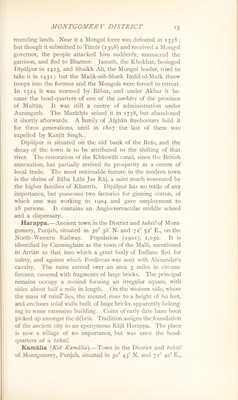
    rounding lands. Near it a Mongol force was defeated in 1358; but though it submitted to Timur (1398) and received a Mongol governor, the people attacked him suddenly, massacred the garrison, and fled to Bhatner. Jasrath, the Khokhar, besieged Dipalpur in 1423, and Shaikh All, the Mongol leader, tried to take it in 1431 ; but the Malik-ush-Shark Imad-ul-Mulk threw troops into the fortress and the Mongols were forced to retreat. In 1524 it was stormed by Babar, and under Akbar it be- came the head-quarters-of one of the sarkdrs of the province of Multan. It was still a centre of administration under Aurangzeb. The Marathas seized it in 1758, but abandoned it shortly afterwards. A family of Afghan freebooters held it for three generations, until in 1807 the last of them was expelled by Ranjit Singh., < Dipalpur is situated oh the old bank of the Beas, and the decay of the town is to be attributed to the shifting of that river. The restoration of the Khanwah canal, since the British annexation, has partially revived its prosperity as a centre of local trade. The most noticeable feature in the modern town is the shrine of Baba Lalu Jas Raj, a saint much venerated by the higher families of Khattrls. Dipalpur has no trade of any importance, but possesses two factories for ginning cotton, of which one was working in 1904 and gave employment to 18 persons. It contains an Anglo-vernacular middle school and a dispensary. Harappa.—Ancient town in the District and tahsil of Mont- gomery, Punjab, situated in 30° 38' N. and 72° 52^ E., on the North-Western Railway. Population (1901), 1,030. It is identified by Cunningham as the town of the Malli, mentioned in Arrian as that into which a great body of Indians fled for safety, and against which Perdiccas was sent with Alexander’s cavalry. The ruins extend over an area 3 miles in circum- - ference, covered with fragments of large bricks. The principal remains occupy a mound forming an irregular square, with sides about half a mile in length. On the western side, where the mass of ruin^lies, the mound rises to a height of 60 feet, and encloses solid walls built of huge bricks, apparently belong- ing to some extensive building. Coins of early date have been picked up amongst the debris. Tradition assigns the foundation of the ancient city to an eponymous Raja Harappa. The place is now a village of no importance, but was once the head- quarters of a tahsil. Kamalia i^Kot Kamdlid).—Town in the District and tahsil of Montgomery, Punjab, situated in 30° 43' N. and 72° 40' E.,
    page 11
    43
    page 12
    44
    page 13
    45
    page 14
    46
    page 15
    47
    page 16
    48
    Previous page
    Next page
    Wellcome Collection

    183 Euston Road
    London NW1 2BE

    +44 (0)20 7611 2222
    info@wellcomecollection.org

    • Getting here

    Today’s opening times

    • Galleries
      10:00 – 18:00
    • Library
      10:00 – 16:00
    • Café
      10:00 – 18:00
    • Shop
      10:00 – 18:00

    Opening times

    Our building has:

    • Step free access
    • Hearing loops

    Accessibility

    • Visit us
    • What’s on
    • Stories
    • Collections
    • Get involved
    • About us
    • Contact us
    • Jobs
    • Media office
    • Developers
    • Privacy and terms
    • Cookie policy
    • Manage cookies
    • Modern slavery statement
    TikTok
    Facebook
    Instagram
    YouTube

    Except where otherwise noted, content on this site is licensed under a Creative Commons Attribution 4.0 International Licence