Wellcome Collection homepage
  • Visit us
  • What’s on
  • Stories
  • Collections
  • Get involved
  • About us
Sign in to your library account
Search for anything
Library account
Take me back to the item page

Punjab.

Date:
1908
Catalogue details

Licence: In copyright

Credit: Punjab. Source: Wellcome Collection.

  • Cover
  • Title Page
  • Table of Contents
  • Index
  • Cover
    474/486 (page 442)
    Previous page
    Next page
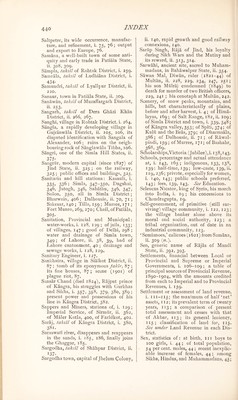
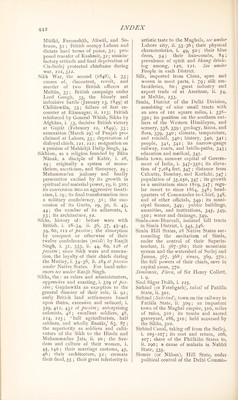
    Mudki, Ferozeshah, Aliwal, and So- braon, 32 ; Fritisb occupy Lahore and dictate hard terms of peace, 32; pro- posed transfer of Kashmir, 32; unsatis- factory attitude and final deprivation of Cis-Sutlej protected chieftains during war, 222, 322. Sikh War, the second (1848), i. 33; causes of, discontent, revolt, and murder of two British officers at Multan, 33; British campaign under Lord Gough, 33, the bloody and indecisive brattle (January 13, 1849) at Chilianwala, 33; failure of first en- counter at Ramnagar, ii. 113; British reinforced by General Whish, Sikhs by Afghans, i. 33, decisive British victory at Gujrat (February 22, 1849), 33 ; annexation (March 29) of Punjab pro- claimed at Lahore, 33 ; deprivation of disloyal chiefs, 221, 222; resignation on a pension of Maharaja Dalip Singh, 34. Sikhism, as a religion founded by Baba Nanak, a disciple of Kabir, i. 28, 29; originally a system of mono- theism, asceticism, and theocracy, 29 ; Muhammadan jealousy and finally persecution excited by its growth in spiritual and material power, 29, ii. 310; its conversion into an aggressive fanati- cism, i. 29 ; its final transformation into a military confederacy, 31; the suc- cession of its Gurus, 29, 30, ii. 43, 44; the number of its adherents, i. 53; its architecture, 52. Sikhs, history of: before wars with British, i. 28-34, 3^? 37^ 43-45» 59, 60, 112 ef, passim \ the absorption by conquest or otherwise of their twelve confederacies {i7nsls') by Ranjit Singh, i. 31, 333, ii. 44, 60, 128 et passim ; since Sikh wars and annexa- tion, the loyalty of their chiefs during the Mutiny, i. 34-36, ii. 284 et passim binder Native States. For local refer- ences see tmdei' Ranjit Singh. Sikhs, the : as rulers and administrators, oppressive and exacting, i. 329 et pas- sim ; Gujranwala an exception to the general disaster of their rule, ii. 92 ; early British land settlements based upon theirs, excessive and reduced, i. 329, 412, 432 et passbn\ enterprising colonists, 48; excellent soldiers, 48, 224, 225; ‘half agriculturists, half soldiers, and wholly Banias,’ 63, 87 ; the superiority as soldiers and culti- vators of the Sikh to the Hindu and Muhammadan Jats, ii. 20; the free- dom and culture of their women, i. 45, 140 ; their marriage customs, 45, 46; their architecture, 52; cremate their dead, 55 ; their great inferiority in artistic taste to the Mughals, see tmdei' Lahore city, ii. 33-36 ; their physical characteristics, i. 49, 50; their blue dress, 54; their hair-combs, 84; prevalence of spirit and bhang drink- ing among, 120, 121. See under People in each District. Silk, imported from China, spun and woven in most parts, i. 79 ; silk em- broideries, 80; great industry and export trade of at Amritsar, ii. 54, at Multan, 233. Simla, District of the Delhi Division, consisting of nine small tracts with an area of loi square miles, i. 338- 350; its position on the southern out- liers of the Western Himalayas, and scenery, 338, 339 ; geology, fauna, and flora, 339, 340 ; climate, temperature, and rainfall, 340; history, 340, 341; people, 341, 342; its narrow-gauge railway, roads, and bridle-paths, 343; education and medical, 345. Simla town, summer capital of Govern- ment of India, i. 347-350; its eleva- tion of 7,084 feet, 347 ; distance from Calcutta, Bombay, and Karachi, 347 ; population of 35,250, 347 ; its growth as a sanitarium since 1819, 347; lar resort to since 1864, 348; head- quarters of Commander-in-Chief, 348, and of other officials, 349 ; its muni- cipal finance, 349; public buildings, amenities, and institutions, 345, 349, 350 ; water and drainage, 349. Simla-e?^;;z-Bharauli, isolated hill tracts in Simla District, i. 345, 346. Simla Hill States, 28 Native States sur- rounding the sanitarium of Simla, under the control of their Superin- tendent, ii. 367-380; their mountain system and the watershed of Sutlej and Jumna, 367, 368; rivers, 369, 370 ; the full powers of their chiefs, save in capital cases, 370. Simlensis, Flora, of Sir Henry Collett, i. 9. Sind-Sagar Doab, i. 225. Sirhind (or Fatehgarh), tahsil of Patiala State, ii. 301. Sirhind {Sahrhid'), town on the railway in Patiala State, ii. 309; an important town of the Mughal empire, 310, miles of ruins, 310 ; its tombs and sacred graveyard, 286, 310; held accursed by the Sikhs, 310. Sirhind Canal, taking off from the Sutlej, i. 205-207 ; its cost and return, 206, 207; share of the Phulkian States in, ii. 290; a cause of malaria in Nabha State, 335. Sirmur (or Nahan), Hill State, under political control of the Delhi Commis-
    page 437
    469
    page 438
    470
    page 439
    471
    page 440
    472
    page 441
    473
    page 442
    474
    Previous page
    Next page

    Wellcome Collection

    183 Euston Road
    London NW1 2BE

    +44 (0)20 7611 2222
    info@wellcomecollection.org

    • Getting here

    Today’s opening times

    • Galleries
      10:00 – 18:00
    • Library
      10:00 – 18:00
    • Café
      10:00 – 18:00
    • Shop
      10:00 – 18:00

    Opening times

    Our building has:

    • Step free access
    • Hearing loops

    Accessibility

    • Visit us
    • What’s on
    • Stories
    • Collections
    • Get involved
    • About us
    • Contact us
    • Jobs
    • Media office
    • Developers
    • Privacy and terms
    • Cookie policy
    • Manage cookies
    • Modern slavery statement
    TikTok
    Facebook
    Instagram
    YouTube

    Except where otherwise noted, content on this site is licensed under a Creative Commons Attribution 4.0 International Licence