Wellcome Collection homepage
  • Visit us
  • What’s on
  • Stories
  • Collections
  • Get involved
  • About us
Sign in to your library account
Search for anything
Library account
Take me back to the item page

Punjab.

Date:
1908
Catalogue details

Licence: In copyright

Credit: Punjab. Source: Wellcome Collection.

  • Cover
  • Title Page
  • Table of Contents
  • Index
  • Cover
    53/486 (page 21)
    Previous page
    Next page
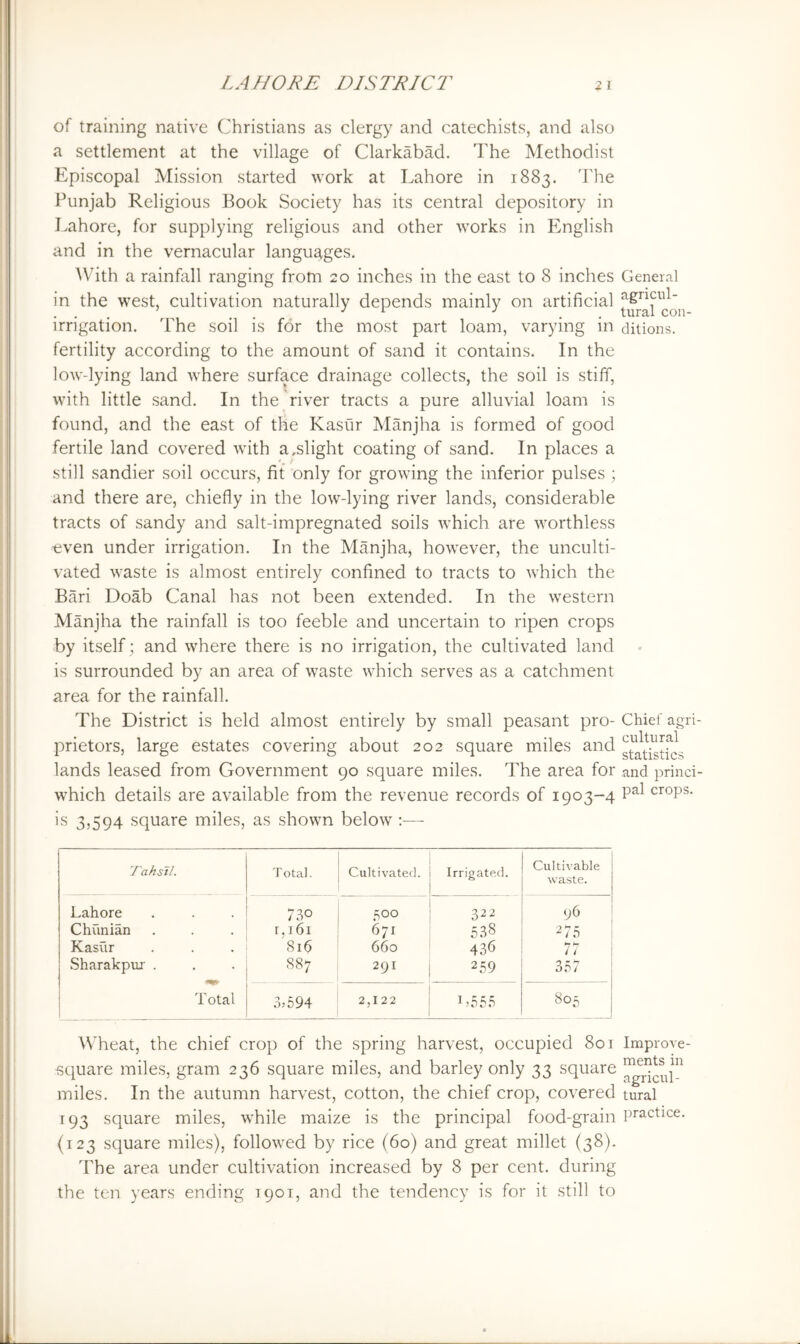
    of training native Christians as clergy and catechists, and also a settlement at the village of Clarkabad. The Methodist Episcopal Mission started work at Lahore in 1883. The Punjab Religious Book Society has its central depository in Lahore, for supplying religious and other works in English and in the vernacular languages. AVith a rainfall ranging from 20 inches in the east to 8 inches General in the west, cultivation naturally depends mainly on artificial irrigation. The soil is for the most part loam, varying in ditions. fertility according to the amount of sand it contains. In the low-lying land where surface drainage collects, the soil is stiff, with little sand. In the river tracts a pure alluvial loam is found, and the east of the Kasur Manjha is formed of good fertile land covered with a,slight coating of sand. In places a still sandier soil occurs, fit only for growing the inferior pulses ; and there are, chiefly in the low-lying river lands, considerable tracts of sandy and salt-impregnated soils which are worthless even under irrigation. In the Manjha, however, the unculti- vated waste is almost entirely confined to tracts to which the Bari Doab Canal has not been extended. In the western Manjha the rainfall is too feeble and uncertain to ripen crops by itself : and where there is no irrigation, the cultivated land is surrounded by an area of waste which serves as a catchment area for the rainfall. The District is held almost entirely by small peasant pro- Chief agri prietors, large estates covering about 202 square miles and lands leased from Government 90 square miles. The area for and prind which details are available from the revenue records of 1903-4 crops, is 3,594 square miles, as shown below :—■ 'fahstl. Total. Cultivated. Irrigated. Cultivable waste. Lahore 730 500 322 96 Chunian r.i6i 671 538 275 Kasur 816 660 436 i t \ Sharakpui' . 887 291 259 357 1 Total 3.594 2,122 1)555 805 1 Wheat, the chief crop of the spring harvest, occupied 801 Improve- square miles, gram 236 square miles, and barley only 33 square miles. In the autumn harvest, cotton, the chief crop, covered tural 193 square miles, while maize is the principal food-grain practice. (123 square miles), followed by rice (60) and great millet (38). The area under cultivation increased by 8 per cent, during the ten years ending 1901, and the tendency is for it still to
    page 17
    49
    page 18
    50
    page 19
    51
    page 20
    52
    page 21
    53
    page 22
    54
    Previous page
    Next page
    Wellcome Collection

    183 Euston Road
    London NW1 2BE

    +44 (0)20 7611 2222
    info@wellcomecollection.org

    • Getting here

    Today’s opening times

    • Galleries
      10:00 – 18:00
    • Library
      10:00 – 16:00
    • Café
      10:00 – 18:00
    • Shop
      10:00 – 18:00

    Opening times

    Our building has:

    • Step free access
    • Hearing loops

    Accessibility

    • Visit us
    • What’s on
    • Stories
    • Collections
    • Get involved
    • About us
    • Contact us
    • Jobs
    • Media office
    • Developers
    • Privacy and terms
    • Cookie policy
    • Manage cookies
    • Modern slavery statement
    TikTok
    Facebook
    Instagram
    YouTube

    Except where otherwise noted, content on this site is licensed under a Creative Commons Attribution 4.0 International Licence