The life of Lorenzo de' Medici, called the Magnificent / by William Roscoe.
- William Roscoe
- Date:
- 1846
Licence: Public Domain Mark
Credit: The life of Lorenzo de' Medici, called the Magnificent / by William Roscoe. Source: Wellcome Collection.
568/574 (page 562)
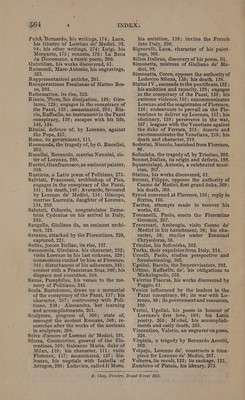
![natural son of Giuliano, duke of Ne- mours, 358; his death, 363; Lorenzo de’, brother of Cosmo, 53; collects remains ‘of antiquity, 309; Lorenzo il Magnifico, born, .70; his early accomplishments, 81; his person and character, 82; education, 82; studies under Landino and Argyropylus, 83; hisinterview with Federigo of Aragon at Pisa, 84; visits Rome, 84; rescues his father from an attempt on his life, 86; defeats the conspiracy of Luca Pitti, 87; letter to him from Ferdinand king .of Naples, 87; his clemency, 88; his Giostra, and poem of Luca Pulci on that subject, 92, 94; his first love, 101; his descrip- tion of his mistress, 102; sonnets in her praise, 103; marries Clarice Orsini, 106; his journey to Milan, 106; his letter to his wife, 107; entrusted with the direc- tion of the Florentine state, 113; ap- pointed syndic of the republic, 115; ‘his splendid entertainment of the duke of Milan, 118; devotes his leisure to. lite- rature, 119; his embassy to Sixtus IV., 122; enlarges his classical collection, 123; suppresses the revolt at Volterra, 123; establishes the academy at Pisa, 125; negotiates for a marriage between the dauphin and a daughter of the king of Naples, 126; his poem entitled Alter- cazione, 132; wounded in the conspi- racy of the Pazzi, 144; Lorenzo de’, conduct after the conspiracy, 148; pre- pares to resist the pope and the king”of Naples, 151; his kindness to the rela- tions of the conspirators, 154; danger of his situation, 157; sends his family to to Pistoia, 158; negotiates for peace, 159; resolves to visit the king of Naples, 162; his letter to the magistrates of Florence, 162; embarks at Pisa, 164;° interview with the king, 164; concludes a treaty with him, 165; his reception at Flo- rence, 167; concludes a peace with the pope, 168; his studies, 169; his criti- cisms on Dante, 172; his early writings, 177; inquiry into his poetical character, 178; his talents for description, 179; poetic comparison, 180; personification, 183; of the passions and affections, 184; his talents for Prosopopeia, 185; various species of poetry cultivated by him, 187; sonnets and lyric pieces, 189; Selve d’ Amore, 191; Ambra, a fable, 191; poem on hawking, 192; moral pieces, 192; sacred poems, 194; I Beoni, asatire, 197; La Nencia da Barberino, 200; dramatic works, 201; Rappresen- tatione, 201; Canti Carnascialeschi, 203; Canzoni a ballo, 204; character of his poetry by Pico of Mirandula and others, 205; celebrated in the Nutricia of Po- litiano, 207; he endeavours to secure the peace of Italy, 211; conspiracy against him by Frescobaldi, 213; de- fends the duke of Ferrara against the Pope and Venetians, 215; obtains the confidence of Innocent VIII., 220 joins the army before Pietra Santa, 221;; defends the king of Naples against Innocent VIII., 223; reconciles the pope and the king, 226; suppresses the insurrection at. Osimo, 227; joins the army, and captures Sarzana, 228 ; pro- tects the {smaller states of Italy, 229; reconciles the [pope and ‘the king of Naples a second time, 232; regulates the government of Florence, 234; his high reputation, 236; his ardour in collecting ancient manuscripts, 244; establishes the Greek academy at Flo- rence, 253; domestic character, 269 ;. accused of being addicted to licentious. amours, 271; vindicated, 272; conduct: towards his children, 273; discharges. his debts, and quits commerce for agri- culture, 277;; favours learned ecclesi- astics, 291; erects a bust of Giotto, 302; encourages the arts, 303; raises a monument to Fra Filippo at Spoleto,. .304; augments his collection of an- tique sculptures, 311; establishes a. school for the study of the antique, 312 ; favours Michelagnolo, 313; other artists. favoured by him,* 317’; attempts to re- vive Mosaic, 321; intends to retire from public life, 325; is taken. sick, and re- moves to Careggi, 326; conduct in his- last sickness, 327 ; ‘interview with Pico. and Politiano, 328; with Savonarola, 329; his death, 330; his character, 331 ;: review of his conduct as a statesman, 831; attachment of the Florentines to. him, 332; circumstances attending his death, 333; testimonies of respect to- his memory, 335; monody on his death by Politiano, 340; Lorenzo de’, duke of Urbino, 357; his death and monu- ment, 360; Lorenzo de’, son of Pier- francesco, called Lorenzino, 362; as- sassinates the duke Alessandro, 365 ; motives and consequences of the at- tempt, 366; is assassinated at Venice,. 367; Lucretia, Lorenzo’s mother, her poetical talent, $1; | Nanina, daughter of Cosmo, 70; Piero de’, son of Cosmo, marries Lucretia Tornabuoni, 70; his conduct after the death of Cosmo, 85; promotes the interests of learning 90, 92; his death and character, 107 ;. Piero de’, son of Lorenzo il Magnifico, born, 272; his character, 276, visits pope Innocent VIII., 283; marries Alfonsina Orsini, 288; visits Milan, 289; expelled from Florence, 338; his death and cha- racter, 348; sonnet by him, 349; Sal- vestro de’, 52; Veri de’, 52. . Merula, Giorgio, his controversy with Po- litiano, 251. Methodists, their doctrines resemble those of the Platonists, 131. prese “4 Michelozzi, Michelozzo, accompanies Cos- mo in his banishment, 57; designs the Medici palace, 77. È Milan, its!]government, 110, , rica](https://iiif.wellcomecollection.org/image/b33028369_0568.jp2/full/800%2C/0/default.jpg)