The animal parasites of man : a handbook for students and medical men / by Max Braun.
- Braun, Max (Maximilian Gustav Christian Carl), 1850-1930.
- Date:
- 1906
Licence: In copyright
Credit: The animal parasites of man : a handbook for students and medical men / by Max Braun. Source: Wellcome Collection.
426/488 (page 402)
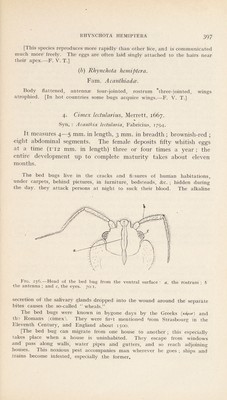
![night. Attracted by lights into houses. Very abundant in 1899 at Washington. Howard cites eases where it was proved to bite man. 18. Melanolestes abdominalis, Herrich-Schäffer (1848). Pirates abdominalis, Herrich-Schäffer ; Melanolestes abdominalis, Uhler, 1875- Allied to the former; some say similar, but can be told by the shorter wings on the female. It occurs in the same localities as M. morio. Fam. LygeeidcB. Scutellum short ; antennae four-jointed ; ocelli present ; membranous part of hemielytra with never more than five nervures. Nearly all vege- table feeders. A few are recorded here as biting man. 19. Lyctocofis campestris, Fabricius. Acanthia campestris, Fabricius. (Lyctocoris domesticus.) Rare in habitations, lives on human blood. Found by Blan- chard in a bed at an hotel at Liverpool. The bite is undoubtedly worse than that of Cimex. Cosmopolitan. In colour it is ferruginous, shining, legs testaceous; hemielytra slightly shorter and narrower than the abdomen ; membranous portion transparent, the apex broadly fuscous. Length 3*8 to 4-8 mm. 20. Rhodinus prolixus, Stal, 1859. Sometimes attacks man, and the bite is very painful. It is 25 mm. long and 8 mm. broad, and occurs in Colombia. It is found also in Cayenne and Venezuela. This like other species is known in South America as Bichuqiie or Benchuca. A few other unimportant species are also recorded as biting man, such as Harpactor cruentas, in the South of France ; Eulyes amcena, from Borneo and Java; Arilus carinatus (Forster), from Brazil. The latter appears to be the same as the Acanthia serratus, Fabricius.—F. V. T.]](https://iiif.wellcomecollection.org/image/b29004755_0426.jp2/full/800%2C/0/default.jpg)