The animal parasites of man : a handbook for students and medical men / by Max Braun.
- Braun, Max (Maximilian Gustav Christian Carl), 1850-1930.
- Date:
- 1906
Licence: In copyright
Credit: The animal parasites of man : a handbook for students and medical men / by Max Braun. Source: Wellcome Collection.
434/488 (page 410)
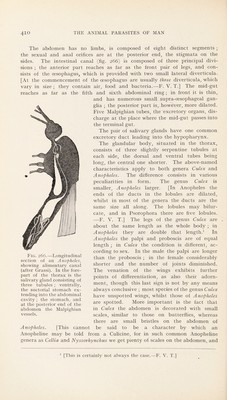
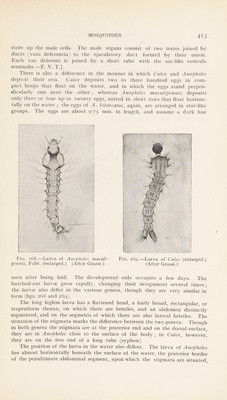
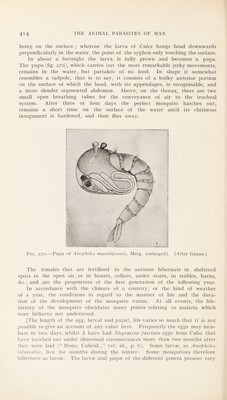
![The abdomen has no limbs, is composed of eight distinct segments ; the sexual and anal orifices are at the posterior end, the stigmata on the sides. The intestinal canal (fig. 266) is composed of three principal divi- sions ; the anterior part reaches as far as the front pair of legs, and con- sists of the, oesophagus, which is provided with two small lateral diverticula. [At the commencement of the oesophagus are usually three diverticula, which vary in size ; they contain air, food and bacteria.—F. V. T.] The mid-gut reaches as far as the fifth and sixth abdominal ring; in front it is thin, and has numerous small supra-oesophageal gan- glia ; the posterior part is, however, more dilated. Five Malpighian tubes, the excretory organs, dis- charge at the place where the mid-gut passes into the terminal gut. The pair of salivary glands have one common excretory duct leading into the hypopharynx. The glandular body, situated in the thorax, consists of three slightly serpentine tubules at each side, the dorsal and ventral tubes being long, the central one shorter. The above-named characteristics apply to both genera Culex and Anopheles. The difference consists in various peculiarities in form. The genus Culex is smaller, Anopheles larger. [In Anopheles the ends of the ducts in the lobules are dilated, whilst in most of the genera the ducts are the same size all along. The lobules may bifur- cate, and in Psorophora there are five lobules. —F. V. T.] The legs of the genus Culex are about the same length as the whole body ; in Anopheles they are double that length.^ In Anopheles the palpi and proboscis are of equal length ; in Culex the condition is different, ac- cording to sex. In the male the palpi are longer than the proboscis ; in the female considerably shorter and the number of joints diminished. The venation of the wings exhibits further points of differentiation, as also their adorn- ment, though this last sign is not by any means always conclusive ; most species of the genus Culex have unspotted wings, whilst those of Anopheles are spotted. More important is the fact that in Culex the abdomen is decorated with small scales, similar to those on butterflies, whereas there are small bristles on the abdomen of Anopheles. [This cannot be said to be a character by which an Anopheline may be told from a Culicine, for in such common Anopheline genera as Cellia and Nyssorhynchus we get plenty of scales on the abdomen, and Fig. 266.—Longitudinal section of an Anopheles, showing alimentary canal (after Grassi). In the fore- part of the thorax is the salivary gland consisting of three tubules ; ventrally, the suctorial stomach ex- tending into the abdominal cavity ; the stomach, and at the posterior end of the abdomen the Malpighian vessels. ‘ [This is certainly not always the case.—F. V. T.]](https://iiif.wellcomecollection.org/image/b29004755_0434.jp2/full/800%2C/0/default.jpg)