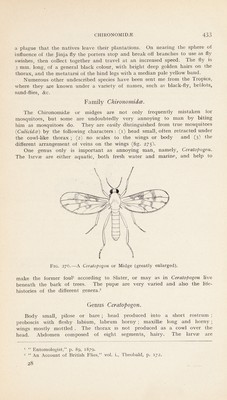
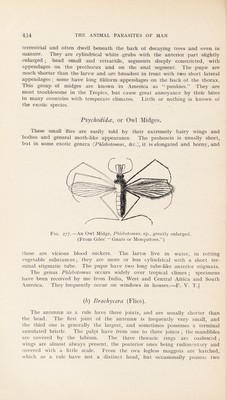
The animal parasites of man : a handbook for students and medical men / by Max Braun.
- Braun, Max (Maximilian Gustav Christian Carl), 1850-1930.
- Date:
- 1906
Licence: In copyright
Credit: The animal parasites of man : a handbook for students and medical men / by Max Braun. Source: Wellcome Collection.
462/488 (page 438)
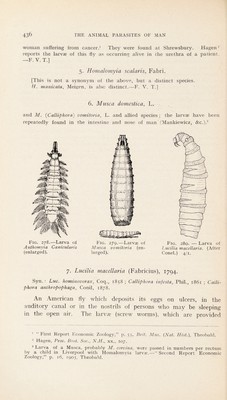
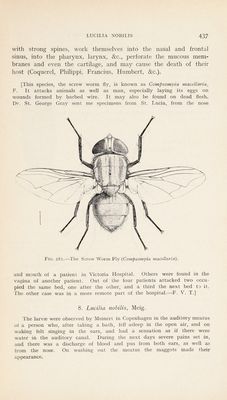
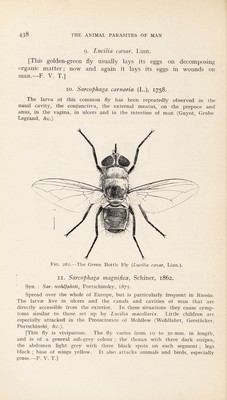
![9. Lucilia ccBsar, Linn. [This golden-green fly usually lays its eggs on decomposing organic matter; now and again it lays its eggs in wounds on man.—F. V. T.] 10. Sarcophaga carnaria (L.), 1758. The larva of this common fly has been repeatedly observed in the nasal cavity, the conjunctiva, the external meatus, on the prepuce and anus, in the vagina, in ulcers and in the intestine of man (Guyot, Grube Legrand, &c.) Fig. 282.—The Green Bottle Fly {Lucilia ccesar, Linn.). II. Sarcophaga magniftca, Schiner, 1862. Syn. ; Sar. isuohlfahrti^ Portschinsky, 1875. Spread over the whole of Europe, but is particularly frequent in Russia. The larvae live in ulcers and the canals and cavities of man that are directly accessible from the exterior. In these situations they cause symp- toms similar to those set up by Lucilia macellaria. Little children are especially attacked in the Protectorate of Mohilew (Wohlfahrt, Gerstäcker, Portschinski, &o.). [This fly is viviparous. The fly varies from 10 to 30 mm. in length, and is of a general ash-grey colour ; the thorax with three dark stripes, the abdomen light grey with three black spots on each segment ; legs black ; base of wings yellow. It also attacks animals and birds, especially geese.—F. V. T.]](https://iiif.wellcomecollection.org/image/b29004755_0462.jp2/full/800%2C/0/default.jpg)