The animal parasites of man : a handbook for students and medical men / by Max Braun.
- Braun, Max (Maximilian Gustav Christian Carl), 1850-1930.
- Date:
- 1906
Licence: In copyright
Credit: The animal parasites of man : a handbook for students and medical men / by Max Braun. Source: Wellcome Collection.
463/488 (page 439)
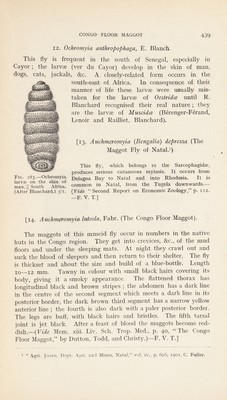
![12. Ochromyia anthropophaga, E. Blanch. This fly is frequent in the south of Senegal, especially in Cayor; the larvae (ver du Ca^/or) develop in the skin of man, dogs, cats, jackals, &c. A closely-related form occurs in the south-east of Africa. In consequence of their manner of life these larvae were usually mis- taken for the larvae of Oestridce until R. Blanchard recognised their real nature; they are the larvae of MuscidcB (Berenger-Ferand, Lenoir and Railliet, Blanchard). [13. Auchmeromyia (Bengalia) depressa (The Maggot Fly of Natal.*) This ß-Y, which belongs to the Sarcophagidae, produces serious cutaneous myiasis. It occurs from Fig. 283.—Ochromyia Bay to Natal and into Rhodesia. It is man^;] South^ ^Africl common in Natal, from the Tugela downwards.— (After Blanchard.) 3/1. {Vide “Second Report on Economic Zoology,” p. 112. —F. V. T.] [14. Auchmeromyia luteola, Fahr. (The Congo Floor Maggot). The maggots of this muscid fly occur in numbers in the native huts in the Congo region. They get into crevices, &c., of the mud floors and under the sleeping mats. At night they crawl out and suck the blood of sleepers and then return to their shelter. The fly is thickset and about the size and build of a blue-bottle. Length 10 12 mm. Tawny in colour with small black hairs covering its body, giving it a smoky appearance. The flattened thorax has longitudinal black and brown stripes ; the abdomen has a dark line in the centre of the second segment which meets a dark line in its posterior border, the dark brown third segment has a narrow yellow anterior line ; the fourth is also dark with a paler posterior border. The legs are buff, with black hairs and bristles. The fifth tarsal joint is jet black. After a feast of blood the maggots become red- dish.—{Vide Mem. xiii. Liv. Sch. Trop. Med., p. 40, “The Congo Floor Maggot,” by Dutton, Todd, and Christy.)—F. V. T.] ' “ Agri. Jonrn. Dept. Agri. and Mines, Natal,” vol. iv., p. 606, 1901, C. Fuller.](https://iiif.wellcomecollection.org/image/b29004755_0463.jp2/full/800%2C/0/default.jpg)