On the theory of certain bands seen in the spectrum / by G.G. Stokes.
- Sir George Stokes, 1st Baronet
- Date:
- 1848
Licence: Public Domain Mark
Credit: On the theory of certain bands seen in the spectrum / by G.G. Stokes. Source: Wellcome Collection.
13/18 page 237
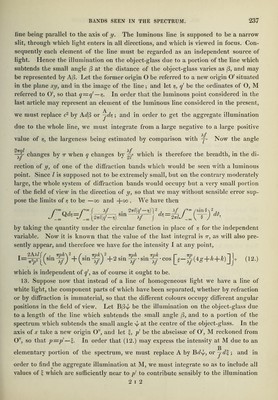
![line being parallel to the axis of y. The luminous line is supposed to be a narrow slit, through which light enters in all directions, and which is viewed in focus. Con- sequently each element of the line must be regarded as an independent source of light. Hence the illumination on the object-glass due to a portion of the line which subtends the small angle ^ at the distance of the object-glass varies as (3, and may be represented by Aj8. Let tlie former origin O be referred to a new origin O' situated in the plane xy, and in the image of the line; and let jj, q' be the ordinates of O, M referred to O', so that q=q'—'^. In order that the luminous point considered in the last article may represent an element of the luminous line considered in the present, we must replace by Ad(3 or -jdri; and in order to get the aggregate illumination due to the whole line, we must integrate from a large negative to a large positive value of ri, the largeness being estimated by comparison with y* Now the angle 2’Kql Kf changes by -r when q changes by which is therefore the breadth, in the di- rection of y, of one of the diffraction bands which would be seen with a luminous point. Since I is supposed not to be extremely small, but on the contrary moderately large, the whole system of diffraction bands would occupy but a very small portion of the field of view in the direction of y, so that we may without sensible error sup- pose the limits of ti to be —oo and -f-oo . We have then f ¥ gjjj 27rl{q'-ri)]2 ^ ^ 2 -00 IM?'-’)) V / Xf /’'»/sin0\2 by taking the quantity under the circular function in place of n for the independent variable. Now it is known that the value of the last integral is t, as will also pre- sently appear, and therefore we have for the intensity I at any point. I: 2AA/f (sin^)'-f (sin^)%2sin^-sin^-cos j, (12.) which is independent of q\ as of course it ought to be. 13. Suppose now that instead of a line of homogeneous light we have a line of white light, the component parts of which have been separated, whether by refraction or by diffraction is immaterial, so that the different colours occupy different angular positions in the field of view. Let be the illumination on the object-glass due to a length of the line which subtends the small angle |3, and to a portion of the spectrum which subtends the small angle tiie centre of the object-glass. In the axis of X take a new origin O, and let p' be the abscissae of O', M reckoned from O, so that p=p’—^. In order that (12.) may express the intensity at M due to an g elementary portion of the spectrum, we must replace A by Bd-^p, or -jd^ ; and in order to findjthe aggregate illumination at M, we must integrate so as to include all values of i which are sufficiently near to // to contribute sensibly to the illumination 2 I 2](https://iiif.wellcomecollection.org/image/b28754190_0015.jp2/full/800%2C/0/default.jpg)
 No text description is available for this image
 No text description is available for this image
 No text description is available for this image