The oxidases and other oxygen - catalysts concerned in biological oxidations / by J. H. Kastle.
- Joseph Hoeing Kastle
- Date:
- [1910]
Licence: In copyright
Credit: The oxidases and other oxygen - catalysts concerned in biological oxidations / by J. H. Kastle. Source: Wellcome Collection.
24/168 (page 22)
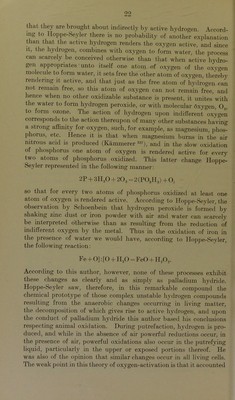
![that they are brought about indirectly by active hydrogen. Accord- ing to Hoppe-Seyler there is no probability of another explanation than that the active hydrogen renders the oxygen active, and since it, the hydrogen, combines with oxygen to form water, the process can scarcely be conceived otherwise than that when active hydro- gen appropriates' unto itself one atom of oxygen of the oxygen molecule to form water, it sets free the other atom of oxygen, thereby rendering it active, and that just as the free atom of hydrogen can not remain free, so this atom of oxygen can not remain free, and hence when no other oxidizable substance is present, it unites with the water to form hydrogen peroxide, or with molecular Oxygen, 02, to form ozone. The action of hydrogen upon indifferent oxygen corresponds to the action thereupon of many other substances having a strong affinity for oxygen, such, for example, as magnesium, phos- phorus, etc. Hence it is that when magnesium burns in the air nitrous acid is produced (Kiimmerer 237), and in the slow oxidation of phosphorus one atom of oxygen is rendered active for every two atoms of phosphorus oxidized. This latter change Hoppe- Seyler represented in the following manner: 2P + 3II20 + 202 = 2 (P03PI3) + O, so that for every two atoms of phosphorus oxidized at least one atom of oxygen is rendered active. According to Hoppe-Seyler, the observation by Schoenbein that hydrogen peroxide is formed by shaking zinc dust or iron powder with air and water can scarcely be interpreted otherwise than as resulting from the reduction of indifferent oxygen by the metal. Thus in the oxidation of iron in the presence of water we would have, according to Hoppe-Seyler, the following reaction: Fe + O]: [O + H20 = FeO + II202. According to this author, however, none of these processes exhibit these changes as clearly and as simply as palladium hydride. Hoppe-Seyler saw, therefore, in this remarkable compound the chemical prototype of those complex unstable hydrogen compounds resulting from the anaerobic changes occurring in living matter, the decomposition of which gives rise to active hydrogen, and upon the conduct of palladium hydride this author based his conclusions respecting animal oxidation. During putrefaction, hydrogen is pro- duced, and while in the absence of air powerful reductions occur, in the presence of air, powerful oxidations also occur in the putrefying liquid, particularly in the upper or exposed portions thereof. He was also of the opinion that similar changes occur in all living cells. The weak point in this theory of oxygen-activation is that it accounted](https://iiif.wellcomecollection.org/image/b28076631_0024.jp2/full/800%2C/0/default.jpg)