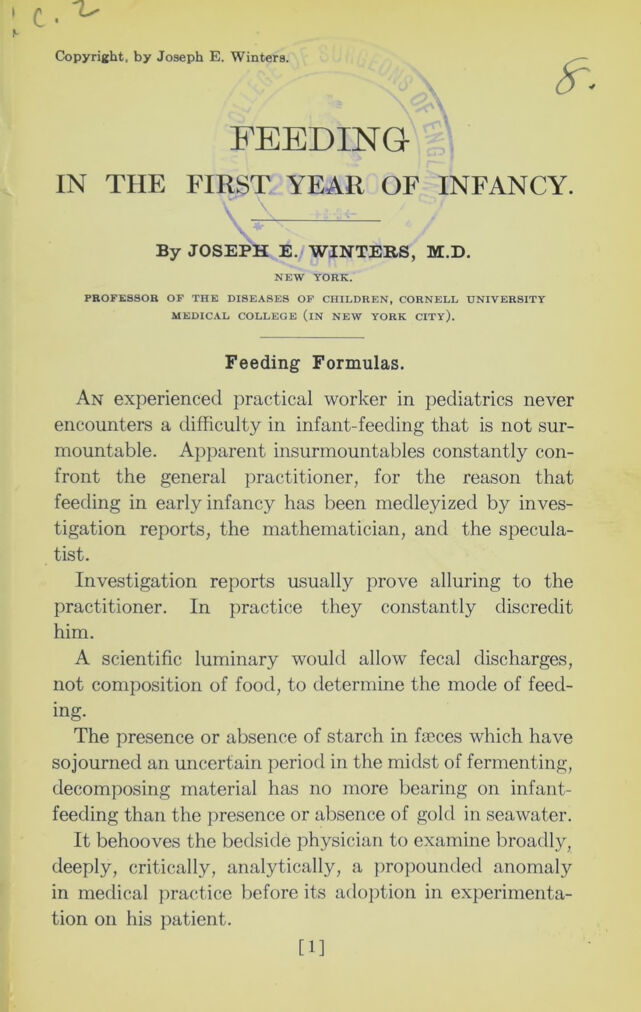
Feeding in the first year of infancy / by Joseph E. Winters.
- Winters, Joseph Edcil, 1848-1922.
- Date:
- [1903]
Licence: In copyright
Credit: Feeding in the first year of infancy / by Joseph E. Winters. Source: Wellcome Collection.
Provider: This material has been provided by The Royal College of Surgeons of England. The original may be consulted at The Royal College of Surgeons of England.
7/16 page 7
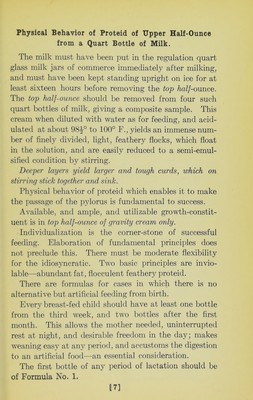
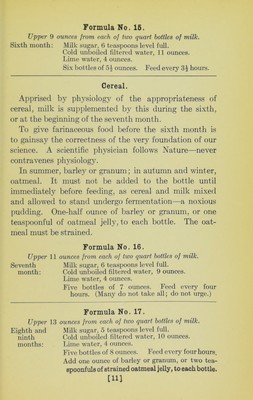
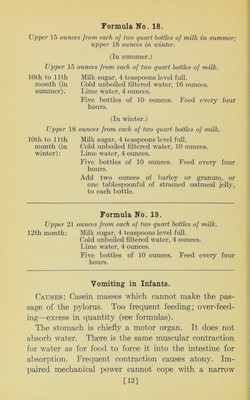
![Physical Behavior of Proteid of Upper Half-Ounce from a Quart Bottle of Milk. The milk must have been put in the regulation quart glass milk jars of commerce immediately after milking, and must have been kept standing upright on ice for at least sixteen hours before removing the top half-ounce. The top half-ounce should be removed from four such quart bottles of milk, gi\dng a composite sample. This cream when diluted with water as for feeding, and acid- ulated at about 98^° to 100° F., yields an immense num- ber of finely divided, light, feathery flocks, which float in the solution, and are easily reduced to a semi-emul- sified condition by stirring. Deeper layers yield larger and tough curds, which on stirring stick together and sink. Physical behavior of proteid which enables it to make the passage of the pylorus is fundamental to success. Available, and ample, and utilizable growth-constit- uent is in top half-ounce of gravity cream only. Individualization is the corner-stone of successful feeding. Elaboration of fundamental principles does not preclude this. There must be moderate flexibility for the idiosyncratic. Two basic principles are invio- lable—abundant fat, flocculent feathery proteid. There are formulas for cases in which there is no alternative but artificial feeding from birth. Every breast-fed child should have at least one bottle from the third week, and two bottles after the first month. This allows the mother needed, uninterrupted rest at night, and desirable freedom in the day; makes weaning easy at any period, and accustoms the digestion to an artificial food—an essential consideration. The first bottle of any period of lactation should be of Formula No. 1. [7]](https://iiif.wellcomecollection.org/image/b22480092_0009.jp2/full/800%2C/0/default.jpg)