Diphtheria / by William P. Northrup ; measles, scarlatina, German measles / by Theodor von Jürgensen ; ed., with additions by William P. Northrup ; authorized translation from the German, under the editorial supervision of Alfred Stengel.
- Northrup, William P. (William Percy), 1851-
- Date:
- 1902
Licence: In copyright
Credit: Diphtheria / by William P. Northrup ; measles, scarlatina, German measles / by Theodor von Jürgensen ; ed., with additions by William P. Northrup ; authorized translation from the German, under the editorial supervision of Alfred Stengel. Source: Wellcome Collection.
35/768 (page 27)
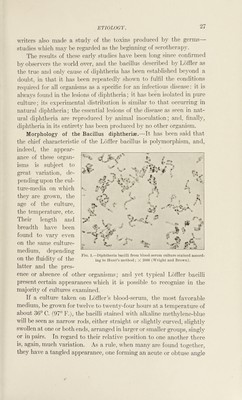
![writers also made a study of the toxins produced by the germs— studies which may be regarded as the beginning of serotherap}^ The results of these early studies have been long since confirmed by observers the world over, and the bacillus described by Loftier as the true and only cause of diphtheria has been established beyond a doubt, in that it has been repeatedly shown to fulfil the conditions required for all organisms as a specific for an infectious disease: it is always found in the lesions of diphtheria; it has been isolated in pure culture; its experimental distribution is similar to that occurring in natural diphtheria; the essential lesions of the disease as seen in nat- ural diphtheria are reproduced by animal inoculation; and, finally, diphtheria in its entirety has been ]Droduced by no other organism. Morphology of the Bacillus diphtheriae.—It has been said that the chief characteristic of the Loffler bacillus is polymorphism, and, indeed, the appear- ance of these organ- isms is subject to great variation, de- pending upon the cul- ture-media on which they are grown, the age of the culture, the temperature, etc. Their length and breadth have been found to vary even on the same culture- medium, depending , £1 • I’j. f Fig. 1.—Diplitlieria bacilli from blood-serum culture stained accord- On the fluidity ol the iug to Hunt’s method; X (Wright and Itrown). latter and the pres- ence or absence of other organisms; and yet typical Loffler bacilli present certain appearances which it is jiossible to recognize in the majority of cultures examined. If a culture taken on Loffler’s blood-serum, the most favorable medium, be grown for twelve to twenty-four hours at a temperature of about 36° C. (97° h\), the bacilli stained with alkaline methylene-blue will be seen as narrow rods, either straight or slightly curved, slightly swollen at one or both ends, arranged in larger or smaller groups, singly or in pairs. In regard to their relative position to one another there is, again, much variation. As a rule, when manv are found together, they have a tangled appearance, one forming an acute or obtuse angle](https://iiif.wellcomecollection.org/image/b29012302_0035.jp2/full/800%2C/0/default.jpg)