Diphtheria / by William P. Northrup ; measles, scarlatina, German measles / by Theodor von Jürgensen ; ed., with additions by William P. Northrup ; authorized translation from the German, under the editorial supervision of Alfred Stengel.
- Northrup, William P. (William Percy), 1851-
- Date:
- 1902
Licence: In copyright
Credit: Diphtheria / by William P. Northrup ; measles, scarlatina, German measles / by Theodor von Jürgensen ; ed., with additions by William P. Northrup ; authorized translation from the German, under the editorial supervision of Alfred Stengel. Source: Wellcome Collection.
47/768 page 39
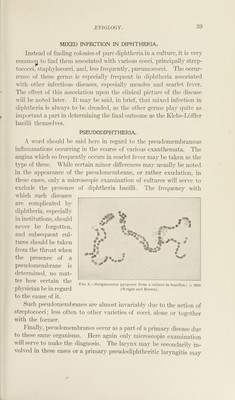
![MIXED INFECTION IN DIPHTHERIA, Instead of finding colonies of ])ure diplitlieria in a culture, it is very common to find them associated with various cocci, principally strep- tococci, staphylococci, and, less frequently, pneumococci. The occur- rence of these germs is especially frequent in dii)htheria associated with other infectious diseases, especially measles and scarlet fever. The effect of this association iq^on the clinical picture of the disease will be noted later. It may be said, in brief, that mixed infection in diphtheria is always to be dreaded, as the other germs play quite as important a part in determining the final outcome as the Klebs-Loffler bacilli themselves. PSEUDODIPHTHERIA. A word should be said here in regard to the pseudomembranous inflammations occurring in the course of various exanthemata. The angina which so frequently occurs in scarlet fever may be taken as the type of these. While certain minor differences may usually i)e noted in the appearance of the pseudomembrane, or rather exudation, in these cases, only a microscopic examination of cultures will serve to exclude the presence of di})htheria bacilli. The frecpiency with which such diseases are complicated by diphtheria, especially in institutions, should never be forgotten, and subsequent cul- tures should be taken from the throat when the presence of a pseudomembrane is determined, no mat- ter how certain the . . . r lo. 6.—Streptococcus pyoRcties from a culture in bouillon ; X 2000 physician be in regard (Wrigin ami Hrown). to the cause of it. Such pseudomembranes are almost invariably due to the action of streptococci; less often to other varieties of cocci, alone or together with the former. Finally, pseudomembranes occur as a ]iart of a ])rimarv disease due to these same organisms. Here again only microscopic examination will serve to make the diagnosis. The larynx may be secondarily in- volved in these cases or a primary pseudodiphtheritic laryngitis may](https://iiif.wellcomecollection.org/image/b29012302_0047.jp2/full/800%2C/0/default.jpg)



 No text description is available for this image
 No text description is available for this image
 No text description is available for this image