A report on the influence of milk in spreading zymotic disease : with a tabular analysis of forty-eight outbreaks / by Ernest Hart.
- Ernest Abraham Hart
- Date:
- 1897
Licence: Public Domain Mark
Credit: A report on the influence of milk in spreading zymotic disease : with a tabular analysis of forty-eight outbreaks / by Ernest Hart. Source: Wellcome Collection.
Provider: This material has been provided by The Royal College of Surgeons of England. The original may be consulted at The Royal College of Surgeons of England.
24/26 page 22
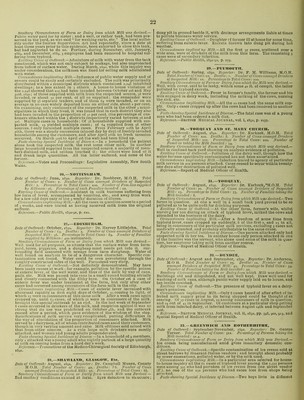
![Sanitary Circumstances o] Farm or Dairy from which Milk was derived — Public water paid for by meter; and a well, or I'atlier tank, had been pre- served in the yard, as was said “ for washing carts, etc.” The local autho- rity under the Dairies Supervision Act had repeatedly, since a date at least three years prior to this epidemic, been exhorted to close this tank, but had neglected to do so. Further, during November, i88S, January, 1S89, and December, 1S89, 3 employees had been removed to hospital suf- fering from typhoid. Exciting Cause 0/ Oidftrenft.—Admixture of milk with water from the tank mentioned, which was not only subject to soakage, but also unprotected from inflow of surface water. During March, 1890, while this inquiry was under consideration, the milkman was fined for selling milk adulterated with water. Circumstances implicating Milk.—In&aence of public water supply and of sewers could be easily arid certainly excluded. The milkwas principally distributed within 2 municipal districts which contained 2,248 inhabited dwellings; to a less extent in 3 others. A house-to house visitation of the 2,248 showed that 102 had been invaded between October ist and May 31st, 1890; of those supplied with milk from the suspected source, 38 were invaded, or about 30 per cent, of all so supplied; the remainder were supplied by 58 separate traders, and of them 64 were invaded, or on an average in no case widely departed from on either side, about 2 per cent. On examining, only customers of the suspected milk in the other 3 muni- cipalities in which they lived, it was found that in each district they also had been invaded in the proportion of 30 per cent, (the percentage of cus- tomers attacked within the 5 districts respectively varied between 26 and 31) Multiple cases in households: Of 38 households supplied with sus- pected milk, 15 yielded multiple cases; of 64 supplied from 58 other sources, 8 only furnished multiple cases. From February loth to April i6th, there was a steady succession (almost day by day) of freshly-invaded households among the customers, and after April i6th no fresh invasion occurred. Ou March 31st to April ist the well had been filled up. Facts shov ing Special Incidence of Disea-e.—ln i household the patient alone took the suspected milk, the rest some other milk. In another large household supplied from the suspected source, a majority of mem- bers disliked milk, and seldom touched it; the others were fond of it and drank large quantities. All the latter suffered, and none of the former. 7,V/crence.—Votes and Proceedings: Legislative Assembly, New South Wales. SG.—NOTTINblllAM. Date of Outbreak: June, 1890. Reporter: Dr. Boobbyer, M.O.H. Total Fvmber of Cases: 7. Number of Cases amongst Drinkers of Suspected Milk: 7. 'Percentage to Total Cases: too. Number of Fam.lies supplied by Milkman: 26. Percentage of such Families invad-d : 27. Exciting Cause of Outbreak.—'Assistant in milk business suffering from low form of fever, accompanied by vomiting, etc., and away from work for a few odd days only of the 3 weeks’ duration of illness. Circumstanccsiinplicaling Milk.—All the cases in question arose in aperiod of 3 weeks, and were traced as having received milk from the original sufferer. Reference.—Public Health, 1890-91, p. no. 27.—EOISIBURbiH. Dale of Outbreak: October, 1S90. Reporter : Dr. Ifarvey Littlejohn. Total Number of Cases: 63. Deaths: 3. Number of Cases amongst Drinkers of ISiispected Milk: 56. Percentage to Total Cases: 89. Number of Families supplied by Milkman: 400 (estimated). Hanilary Circumstances of Farm or Dairy from udiich Milk was derived.— Well, used for all purposes, so situate that the surface water from farm- yard, byres, piggeiies, and a dungheap must needs get into it. sur- rounding field manured with sewage from farm dungheap. Water of well found on analysis to be of a dangerous character. Specific con- tamination not found. Water could be seen percolating through the roughly-constructed sides of the well. Farmstead very dirty. Exciting Cause of Outbreak.—Not definitely demonstrated. May have been many causes at work—for example, pollution by the specific poison of enteric fever, of the well water, and thus of the milk by way of cans, pails, etc. Milk was passed into cans in a small round building aerially and closely connected with the filthy byre. On October ist a case of enteric fever was under treatment at the farm, but only after other cases had occurred among consumers of the farm milk in the city. Circumstances implicating Milk.—Cases of enteric fever increased with abnormal rapidity in first eight days of October, 33 coming to light, of which 25 were in consumers of this same milk After a week cases again cropped up, until 63 cases, of which 56 were in consumers of the milk, brought this special outbreak to an end. In the last week of September 8 cases occurred in drinkers of the milk, and suspicion against it was so .‘•trong that its use was prohibited on October 4th, and the outbreak ceased after a period, which gave evidence of the wisdom of the step. Ramifications of milk service very complicated, putting difficulties in the way of elucidation of the proportion of consumers attacked. Milk served to 7 dairymen, all of whom contributed cases amid their customers, though in very varying amount and ratio Milk ofttimes sold mixed with that from other sources. As a rule large milk drinkers were mostly attacked, and women and young adults preponderated. Fads showing Special Incidence of Disease.—In a household of 9 members, only I attacked was ayoung adult who nightly partook of a large quantity of iiiilk on coming home from a hard day's work. Reference.—Transactions of the Medico-Chirurgical Society of Edinburgh, 1891. 28.—SHAWIAND, OIASGOW, Etc. Date of Outbreak: August, 1891. Reporter: Dr. Campbell Munro, County M O.H. Tottd Number of Cases: 42. Deaths: ?6. Number of Cases amongst Drinkers of Suspected Milk: 37. Percentage of Total Cases : 88. Sanitary Circumstances of Farm or Dairy from which Milk was Derived — Badsauitaiy conditions existed at farm. Byre defective iu sUuclure; dung pit in ground beside it, with drainage arrangements liable at times to pollute business water service. Exciting Cause of Oulbreak.—Daughter of farmer ill athomefor some time, suffering from enteric fever. Excreta thrown into dung pit during hot weather. Circumstances impUcat 'ng Milk.—All the first 37 cases, scattered over a wide area, were of drinkers of the milk from this farm. The remaining s cases were of secondary infection. Reference.—Public Health, 1891-92, p. 275. 20.—PIAMOETH. Date of Outbreak: Spring, 1892. Reporter: Dr. P. M. 'W'illiams, M.O.H. Total Number of Cases :i2. Deaths; r. Number of Cases amongst Drinkers of Suspected Milk: 12. Percentage to Total Cases: 100. Sanitary Circumstances of Farm or Dairy from which the Milk was derived.— Well, with cover, said to be leaky, within some 40 ft. of cesspit, the latter polluted by typhoid excreta. Exciting Cause of Outbreak.—Fever in farmer’s family, the farmer and his wife engaged iu dairy work, including the milking of the cows, nursing the sick, etc. Circumstances implicating Milk.—All the 12 cases had the same milk sup- ply. Only 2 cases cropped up after the cows had been removed to another farm. Facts showing Special Incidence of Disease.—The fatal case was of a young man who had been ordered a milk diet. Jfe/erence.—British Medical Journal, vol. i, 1892, p. 1157. 30.—TORaEAA AN» ST. MARY CllVRClI. Date of Outbreak: August, 1892. Reporter: Dr. Karkeek, M.O.H. Total Number of Cases: 102. Deaths: 8. Number of Cases amongst Dnnkers of Suspected Milk: 102. Percentage to Total Cases: 100. Number of Famil'es taking the Milk Invaded: '54. Sanitary Circumstances of Farm or Dairy from which Milk soas derived.— Well in confined back yarn showing on analysis evidence of pollution. Exciting Cause of Oidturnl:.—Pollution of the dairy well, though how the water became specifically contaminated has not been ascertained. Circumstances implicating J/iR-.—Infection traced to agency of particular milk service in 102 persons attacked. Cases ceased to occur within twenty- one days after destruction of poltuted well. Jfe/emice.—Report of Medical Officer of Health. 31.—TORUUAY. Date of Outbreak: August, 1892. Reporter: Dr. Karkeek,M.O.H. Total Number of Cases: 20. Nmnber of Cases amongst Drinkers of Suspected Milk: 15. Percentage to Total Cases: TS. N umber of Families taking the Milk invaded: 8. Sanitary Circumstances of Farm or Dairy from which Milk was derived.--Two farms in question. At one a well in a small back yard proved to be so polluted as to be quite unfit for drinking purposes. Exciting Cause of Outbreak.—At the other farm, farmer’s wife, whilst nursing her son during an attack of typhoid fever, milked the cows and attended to the business of the dairy. Circumstances implicating J/iit.—After a freedom of some time from typhoid fever, cases cropped up suddenly, 6 of the first 7, and 15 in all, being in consumers of the particular milk services, excluding 5 cases not medically attended, and probably attributable to the same cause. Facts showing Special Incidence of Disease.—Ono person attacked only had suspected milk in her tea. In another house only person attacked in one of the families was the servant, who alone used some of the milk in ques- tion, her employer taking milk from another source. ife/erence.—Report of Medical Officer of Health. 32.—UE.YBEE, ' Date of Outbreak: August and September, 1892. J?«pf)rter: Dr. Anderson, .S M.O H. Total A’umber of Cases: 73. Deaths: ii. Number of Cases # amongst Drinkers of Su.speeled Milk: 43. Percentage to Total Cases: 59. Jj Number of Families taking the Milk invaded: 32. ’ < Sanitary Circumstances of Farm or Dairy funn which Milk was derived.— U Buildings old and dilapidated, and not well kept. Draw well used for 'j washing of milk cans, although puDlic water supply laid on to house, and 1 tap inside cowshed. ^ Exciting Cause of Outbreak.—The presence of typhoid fever on a dairy- man’s premises. 2 Circumstances implicating J/®.—Only 8 cases heard of after effect of in- I fected milk supply prior to its being stopped could be thought of as ceasing. Of 37 cases in August, 19 among consumers of milk in question, 9. and 24 out of 45 in September. Of customers at a particular shop getting a milk from infected dairy, 16 infected between August 24th and September a 2lSt. I Reference.—BRmsu Medical Journal, vol. ii, 1892, pp. 598, 902, 915, and Js Special Report of Medical Officer of Health. t 33. —GREENWICH AN» ROTIIERIIITIIE. 9 Date of Outbreak: September-November, 1892. Reporter: Dr. Georee Turner. Total Number of Cases: 511. Percentage of Persons taking the j Milk in vaded .•91.4. f Sanitary Circumstances of Farm or Dairy from which Milk was Derived.— Ice cream being manufactuied amid gross insanitary domestic con- ditions. Exciting Cause of Outbreak.—5pec\h.a contamination of ice cream sold at street barrows by itinerant Italian vendors ; and brought about probably by sewer emanations, polluted water, or by the milk used. Circumstances implicating Milk.—Id a particular area selected for house- to-house inquiry all the 61 cases of typhoid fever among the 1,551 persons were among 394 who had partaken of ice cream from one street vendor (F.), no one of the 232 persons who had eaten ices from shops being attacked. Facts showing Special Incidence of Disease.—Two boys livin in different](https://iiif.wellcomecollection.org/image/b22339966_0026.jp2/full/800%2C/0/default.jpg)