The farmers' medical dictionary for the diseases of animals / By Cuthbert W. Johnson, Esq. F.R.S.
- Cuthbert Johnson
- Date:
- 1845
Licence: Public Domain Mark
Credit: The farmers' medical dictionary for the diseases of animals / By Cuthbert W. Johnson, Esq. F.R.S. Source: Wellcome Collection.
14/296 (page 10)
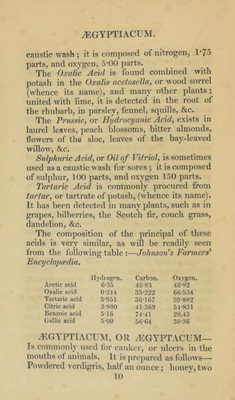
![^.GYPTIACUM. caustic wash ; it is composed of nitrogen, l*/5 parts, and oxygen, 5’00 parts. The Oxalic Acid is found combined witli potash in the Oxalis acetosella, or ^vood sorrel (whence its name), and many other ])lants; united with lime, it is detected in the root of the rhubarb, in parsley, fennel, squills, &c. The Prussic, or Hydrocyanic Acid, exists in laurel leaves, peach blossoms, bitter almonds, flowers of the sloe, leaves of the bay-leaved willow, &c. Sulphuric Acid, or Oil of Vitriol, is sometimes used as a caustic wash for sores ; it is composed of sulphur, 100 parts, and oxygen 150 parts. Tartaric Acid is commonly procured from tartar, or tartrate of ]iotash, (whence its name). It has been detected in many plfints, such as in grapes, bilberries, the Scotch fir, couch grass, dandelion, &c. The composition of the principal of these acids is very similar, as will be readily seen from the following table :—Johnson’s Farmers’ Encyclopedia. Hvdiotfcn. Carbon, Oxvgcn. Acetic acid ' 6-35 46-83 46-82 Oxalic acid 0-2M 33-222 66-534 Tartaric acid 3-951 36-167 59-882 Citric acid 3-800 41-369 51-831 Henzoic acid 5-16 74-41 20.43 Gallic acid 5-00 56-64 38-36 ^.GYPTIACUM, OR yEGYPTACUM— Is commonly used for canker, or \dcers in the mouths of animals. It is pre})ared as follows— Powdered verdigris, half an ounce; honey, two](https://iiif.wellcomecollection.org/image/b28742278_0014.jp2/full/800%2C/0/default.jpg)