Observations on normal growth and development of the human body under systematized exercise : read in the Section on Physiology, First Pan-American Medical Congress, Washington, D.C., September 5-8, 1893 / by Henry G. Beyer.
- Beyer, Henry Gustav, 1850-1918.
- Date:
- [1894?]
Licence: Public Domain Mark
Credit: Observations on normal growth and development of the human body under systematized exercise : read in the Section on Physiology, First Pan-American Medical Congress, Washington, D.C., September 5-8, 1893 / by Henry G. Beyer. Source: Wellcome Collection.
Provider: This material has been provided by The Royal College of Surgeons of England. The original may be consulted at The Royal College of Surgeons of England.
15/26 (page 155)
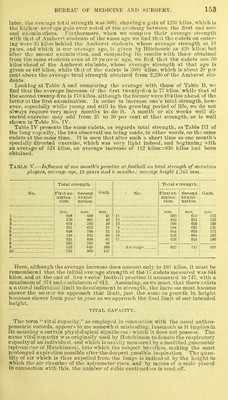
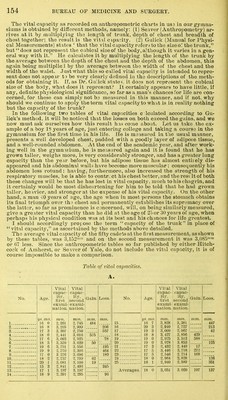
![Table of vital capacities—Continued. B. No. Age. Vital capac- ity, first exami- nation. Vital capac- ity, second exami- nation. Gain. Loss. No. Age. Vital capac- ity, first exami- nation. Vital capac- ity, second exami- nation. Gain. Loss. ]_ ys. mo. 19 11 mm. 4,133 2,673 3,576 3,233 3,126 3,304 3,258 3,276 3,092 3,616 3,399 mm. 3,243 2,916 mm. mm. 890 15 ys. mo. 18 5 mm. 4,132 mm. 3,978 3,924 3,063 mm. mm. 154 2.. 16 0 243 16 18 7 3,762 162 3. 16 6 3,531 3,078 3, 407 45 17 19 3 3. 321 258 4 17 9 155 18 19 8 3,042 3,367 3,044 2,867 3,132 90 5. 19 2 281 19 19 5 3,276 2,436 2, 541 91 6 18 2 2,590 2,898 3,180 2,582 714 20 19 5 608 7 17 3 360 21 18 11 326 8. 18 4 96 22 17 9 3. 078 3,495 417 9... 18 0 510 23 16 3 2,883 2,451 2,740 143 10 .. 19 0 3( 362 3,752 254 24 16 4 2,782 3,488 331 11. . . . 19 0 353 19 7 3,565 77 19 17 8 16 7 3,056 3.226 3.469 3,113 2,727 413 13 i t3 Averages. 18 0 3,252 3,150 92 196 14 16 3 2 827 100 VITAL INDEX. Under the above name Enebuske (loc. cit.) has introduced the ratio of lung ca- pacity and weight of Demeny. This index appears to me to be of considerable physiological significance in connection with the subject of physical training and the study of its results. Fiom the physiological point of view the intro- duction into scientific physical training of valuable and significant indices, such as the above, is as much of a necessity and of as great importance now as was the introduction of weights and measures into chemistry a hundred years ago. The original papers of Demtny are not accessib’e to me, but Dr. Enebuske states that Demeny hi s found that in children of the same age the lung capacity is proportional to their weight, and that if a curve is ecnstructed of lung ca- pacity and weight in function of age, the two curves are parallel. Demeny has furthermore found that the ratio of lung capacity and weight of per. ons who have undergone a course of systematic physical training is much higher than in persons who have had no such training, from the fact familiar to us all, lhat the training on the one hand increases the lung capacity, and, on the other, dimin- ishes at least in the beginning the weight, by causing a great quantity of the. reserve tissue (fat) to disappear. In the adjoining two tables of vital indices I have applied this index to the 50 cadets under observation. It will be noticed, however, that but 16 out of 50 have gained, 31 have lost, and 3 have remained the same. The average vital index obtained from both tables together at the first examination was 0.0679, at the second examination 0.0667, amounting to an average loss of 0.0012. It will furthermore be noticed that for the first time, so far as we have gone in our compai’ative study of these two tables, the first table presents higher averages than the second table. It was found, in other words, that the 25 cadets whose increase in total strength was 100 or more kilos, and who are always rep- resented by Table B were taller, heavier, stronger and had a greater average lung capacity than the 25 whose increase in total strength had been found to be less than 100 kilos, and who are always represented by Table A. In the tables of the vital indices we meet with the first exception to this. An average decrease in vital index of 0.0012 may not be very great, but it is cer- tainly appreciable, and must have a cause, for I firmly believe in the validity and significance of this index. On referring to the tables of the lung ca- pacities and taking Table B. it will be noticed that besides the average in- crease being smaller than in Table A, 5 out of the 25 have remained the same and 3 have actually lost in lung capacity. No matter how disheartening it may be to realize such results, the finding them out is as important and salutary as the obtaining of contrary results would be gratifying.](https://iiif.wellcomecollection.org/image/b22331438_0017.jp2/full/800%2C/0/default.jpg)