Diseases of the heart and aorta / by Thomas E. Satterthwaite.
- Satterthwaite, Thomas E. (Thomas Edward), 1843-1934
- Date:
- [1905]
Licence: Public Domain Mark
Credit: Diseases of the heart and aorta / by Thomas E. Satterthwaite. Source: Wellcome Collection.
Provider: This material has been provided by the Augustus C. Long Health Sciences Library at Columbia University and Columbia University Libraries/Information Services, through the Medical Heritage Library. The original may be consulted at the the Augustus C. Long Health Sciences Library at Columbia University and Columbia University.
18/320 page 14
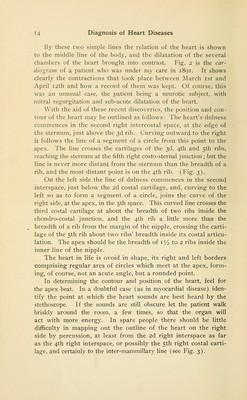
![By these two simple lines the relation of the heart is shown to the middle line of the body, and the dilatation of the several chambers of the heart brought into contrast. Fig. 2 is the car- diogram of a patient who was under my care in 1891. It shows clearly the contractions that took place between ]\larch 1st and April 12th and how a record of thcni was kept. Of course, this was an unusual case, the patient being a neurotic subject, with mitral regurgitation and sub-acute dilatation of the heart. With the aid of these recent discoveries, the position and con- tour of the heart may be outlined as follows: The heart's dulness commences in the second right intercostal space, at the edge of the sternum, just abo\'e the 3d rib. Curving outward to the right it follows the line of a segment of a circle from this point to the apex. The line crosses the cartilages of the 3d. 4th and 5th ribs, reaching the sternum at the fifth right costo-sternal junction ; l)Ut the line is never more distant from the sternum than the breadth of a rib, and the most distant point is on the 4th rib. (Fig. 3). On the left side the line of dulness commences in the second interspace, just below the 2d costal cartilage, and, curving to the left so as to form a segment of a circle, joins the curve of the right side, at the apex, in the 5th space. This curved line crosses the third costal cartilage at about the breadth of two ribs inside the chondro-costal junction, and the 4th rib a little more than the breadth of a rib from the margin of the nipple, crossing the carti- lage of the 5th rib about two ribs' breadth inside its costal articu- lation. The apex should be the breadth of i^ to 2 ribs inside the inner line of the nipple. The heart in life is ovoid in shape, its right and left borders comprising regular arcs of circles which meet at the apex, form- ing, of course, not an acute angle, but a rounded point. In determining the contour and position of the heart, feel for the apex beat. In a doubtful case (as in myocardial disease) iden- tify the point at which the heart sounds are best heard by the stethoscope. If the sounds are still obscure let the patient walk briskly around the room, a few times, so that the organ will act with more energy. In spare people there should be little difficulty in mapping out the outline of the heart on the right side by percussion, at least from the 2d right interspace as far as the 4th right interspace, or possibly the 5th right costal carti- lage, and certainly to the inter-mammillary line (see Fig. 3).](https://iiif.wellcomecollection.org/image/b21208384_0018.jp2/full/800%2C/0/default.jpg)