Diseases of the heart and aorta / by Thomas E. Satterthwaite.
- Satterthwaite, Thomas E. (Thomas Edward), 1843-1934
- Date:
- [1905]
Licence: Public Domain Mark
Credit: Diseases of the heart and aorta / by Thomas E. Satterthwaite. Source: Wellcome Collection.
Provider: This material has been provided by the Augustus C. Long Health Sciences Library at Columbia University and Columbia University Libraries/Information Services, through the Medical Heritage Library. The original may be consulted at the the Augustus C. Long Health Sciences Library at Columbia University and Columbia University.
38/320 page 34
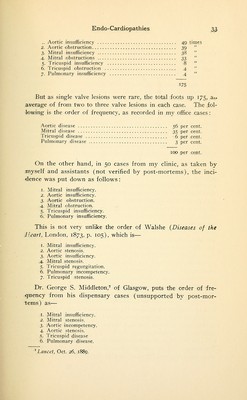
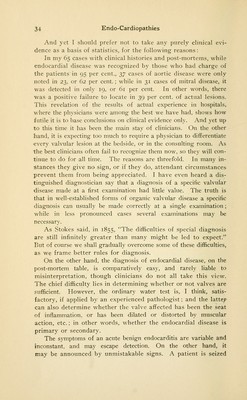
![And yet I should prefer not to take any purely clinieal evi- dence as a basis of statistics, for the following reasons: In my 65 cases with clinical histories and post-mortems, while endocardial disease was recognized by those who had charge of the patients'in 95 per cent., 37 cases of aortic disease were only noted in 27,, or 62 per cent.; while in 31 cases of mitral disease, it was detected in only 19. or ()i ])er cent. In other words, there was a positive failure to locate in 39 per cent, of actual lesions. This revelation of the results of actual experience in hospitals, where the physicians were among the best we have had, shows how futile it is to base conclusions on clinical evidence only. And yet up to this time it has been the main stay of clinicians. On the other liand, it is expecting too much to require a physician to differentiate •every valvular lesion at the bedside, or in the consulting room. As the best clinicians often fail to recognize them now. so the}- will con- tinue to do for all time. The reasons are threefold. In many in- stances they give no sign, or if they do, attendant circumstances prevent them from being appreciated. I have even heard a dis- tinguished diagnostician say that a diagnosis of a specific valvular disease made at a first examination had little value. The truth is that in well-established forms of organic valvular disease a specific diagnosis can usually be made correctly at a single examination ; while in less pronounced cases several examinations may be necessary. As Stokes said, in 1855, The difficulties of special diagnosis are still infinitely greater than many might be led to expect. But of course we shall gradually overcome some of these difficulties, as we frame better rules for diagnosis. On the other hand, the diagnosis of endocardial disease, on the post-mortem table, is comparatively easy, and rarely liable to misinterpretation, though clinicians do not all take this view. The chief difficulty lies in determining whether or not valves are sufficient. However, the ordinary water test is, I think, satis- factory, if applied by an experienced pathologist; and the latte^ can also determine whether the valve affected has been the seat of inflammation, or has been dilated or distorted by muscular action, etc.; in other words, whether the endocardial disease is primary or secondary. The symptoms of an acute benign endocarditis are variable and inconstant, and may escape detection. On the other hand, it may be announced by unmistakable signs. A patient is seized](https://iiif.wellcomecollection.org/image/b21208384_0038.jp2/full/800%2C/0/default.jpg)
 No text description is available for this image
 No text description is available for this image
 No text description is available for this image