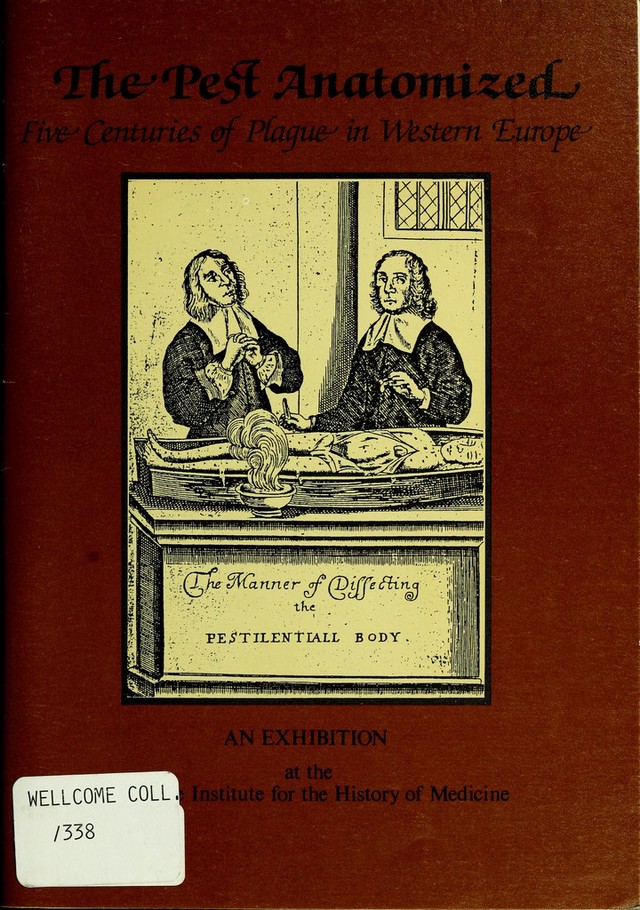
The pest anatomized : five centuries of plague in Western Europe. An exhibition at the Wellcome Institute for the History of Medicine ... 4 March to 24 May 1985 / [compiled by Richard Palmer and Christine English].
- Wellcome Institute for the History of Medicine
- Date:
- 1985
Licence: Attribution 4.0 International (CC BY 4.0)
Credit: The pest anatomized : five centuries of plague in Western Europe. An exhibition at the Wellcome Institute for the History of Medicine ... 4 March to 24 May 1985 / [compiled by Richard Palmer and Christine English]. Source: Wellcome Collection.
21/48 page 11
![Duchy of Savoy: plague precautions. Letter to Carlo Emanuele I, Duke of Savoy (1562-1630), from the Health Board in the eastern part of the Duchy (Magistrat General ... sur la Sante de la les Monts). The letter deals with precautions during an outbreak of plague in the area. Chambery, 23 August 1581. Western MS. 5138. Health passes Health passes (fedi di sanita) issued to Giovanni Francesco Buonamici, of Prato, for various journeys in time of plague. Buonamici was described as aged between 37 and 40, height average or tall, with a dark complexion and a dark brown beard. The passes were issued by the Health Boards of Genoa, Pisa, and Bologna between 1630 and 1632. Western MS. 5139/1,3,6. Sospensione di commercio con tutta la Germania. Printed proclamation by the Health Board of Ferrara, 26 December 1679, banning commerce with the whole of Germany. The ban, brought into force in cooperation with the Health Board of Verona, forbade the movement of people and goods from Germany by land or sea, whether with health passes or without. Minute book of the Mayor and Aldermen of Kingston upon Hull, 1668-70. On 28 August 1668 the Privy Council, taking note of plague in Normandy, ordered that no ship from Rouen, Caen and other infected areas was to unload in British ports before quarantine had been performed. On 8 September the local authorities in Hull put these orders into effect, and laid down fines for disobedience. Western MS. 3109. The execution of offenders against the plague orders. Photograph of a detail from an engraving of plague in Rome in 1656 by G.G. de Rossi (see case 8). In Italy plague control was enforced with deadly seriousness. As late as 1813, during plague in Malta, an English visitor to Sicily was shown the numerous gibbets set up along the coast. 'That, Sir1, he was told, 'is our only defence'. Minute book of the Health Board of Monza during the plague, 1576-77. Plague broke out in Monza, part of the Duchy of Milan, in August 1576. Strict control was enforced by the local Health Board. On 10 September 1576 they appointed officers to take a complete census of the town. This became a means of controlling the population during the epidemic. The same officers were to visit their allotted wards every week, and check that every person was accounted for. Western MS. 570, especially ff. 25v.-27v. Orders thought meete by her Maiestie ... to be executed throughout the counties of this realme, in such townes ... as are, or may be hereafteT infected with the plagueT London, [1588?] — The Privy Council established procedures for the whole country to deal with plague. The inhabitants of infected houses were to be shut up for six weeks and anyone breaking this quarantine was to be punished with the stocks. Officials were to be appointed to view corpses and report on the causes of death, and to watch and provide food for infected houses. Separate burial grounds outside parish boundaries were to be used, and burials were to take place only after sunset. Severe as they were, the orders were humanitarian in intention. Special funds were set up for the relief of the poor and to compensate for infected goods which were burned. -11-](https://iiif.wellcomecollection.org/image/b20457790_0021.jp2/full/800%2C/0/default.jpg)