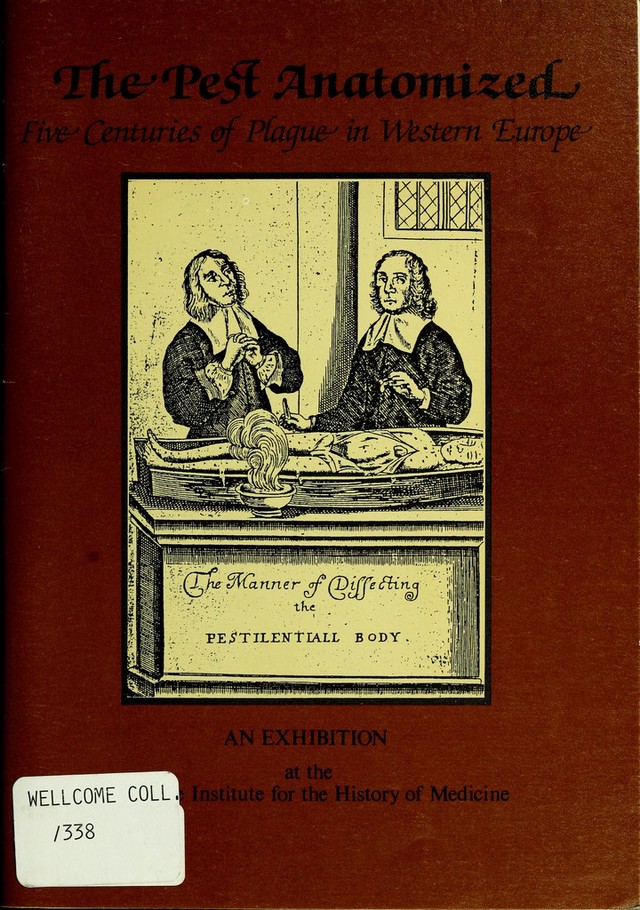
The pest anatomized : five centuries of plague in Western Europe. An exhibition at the Wellcome Institute for the History of Medicine ... 4 March to 24 May 1985 / [compiled by Richard Palmer and Christine English].
- Wellcome Institute for the History of Medicine
- Date:
- 1985
Licence: Attribution 4.0 International (CC BY 4.0)
Credit: The pest anatomized : five centuries of plague in Western Europe. An exhibition at the Wellcome Institute for the History of Medicine ... 4 March to 24 May 1985 / [compiled by Richard Palmer and Christine English]. Source: Wellcome Collection.
26/48 page 16
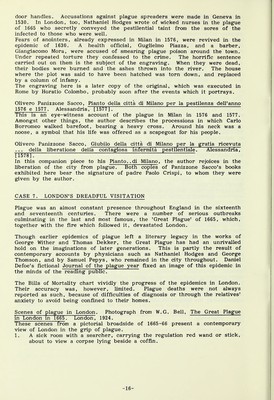
![door handles. Accusations against plague spreaders were made in Geneva in 1530. In London, too, Nathaniel Hodges wrote of wicked nurses in the plague of 1665 who secretly conveyed the pestilential taint from the sores of the infected to those who were well. Fears of anointers, already expressed in Milan in 1576, were revived in the epidemic of 1630. A health official, Guglielmo Piazza, and a barber, Giangiacomo Mora, were accused of smearing plague poison around the town. Under repeated torture they confessed to the crime. The horrific sentence carried out on them is the subject of the engraving. When they were dead, their bodies were burned and the ashes thrown into the river. The house where the plot was said to have been hatched was torn down, and replaced by a column of infamy. The engraving here is a later copy of the original, which was executed in Rome by Horatio Colombo, probably soon after the events which it portrays. Olivero Panizzone Sacco, Pianto della citta di Milano per la pestilenza dell*anno 1576 e 1577. Alessandria, [1577]. This is an eye-witness account of the plague in Milan in 1576 and 1577. Amongst other things, the author describes the processions in which Carlo Borromeo walked barefoot, bearing a heavy cross. Around his neck was a noose, a symbol that his life was offered as a scapegoat for his people. Olivero Panizzone Sacco, Giubilo della citta di Milano per la gratia ricevuta ... della liberatione della contagiosa infermita pestilentiale. Alessandria, [1578]. In this companion piece to his Pianto.. di Milano, the author rejoices in the liberation of the city from plague! Both copies of Panizzone Sacco's books exhibited here bear the signature of padre Paolo Crispi, to whom they were given by the author. CASE 7. LONDON'S DREADFUL VISITATION Plague was an almost constant presence throughout England in the sixteenth and seventeenth centuries. There were a number of serious outbreaks culminating in the last and most famous, the 'Great Plague' of 1665, which, together with the fire which followed it, devastated London. Though earlier epidemics of plague left a literary legacy in the works of George Wither and Thomas Dekker, the Great Plague has had an unrivalled hold on the imaginations of later generations. This is partly the result of contemporary accounts by physicians such as Nathaniel Hodges and George Thomson, and by Samuel Pepys, who remained in the city throughout. Daniel Defoe's fictional Journal of the plague year fixed an image of this epidemic in the minds of the reading public. The Bills of Mortality chart vividly the progress of the epidemics in London. Their accuracy was, however, limited. Plague deaths were not always reported as such, because of difficulties of diagnosis or through the relatives' anxiety to avoid being confined to their homes. Scenes of plague in London. Photograph from W.G. Bell, The Great Plague in London in 1665. London, 1924. These scenes from a pictorial broadside of 1665-66 present a contemporary view of London in the grip of plague. 1. A sick room with a searcher, carrying the regulation red wand or stick, about to view a corpse lying beside a coffin. -16-](https://iiif.wellcomecollection.org/image/b20457790_0026.jp2/full/800%2C/0/default.jpg)