Volume 1
Promptorium parvulorum sive clericorum, lexicon Anglo-Latinum princeps / auctore fratre Galfrido grammatico dicto e predicatoribus lenne episcopi, northfolciensi, A.D. circa M.CCCC.XL. Olim e prelis Pynsonianis editum, nunc ab integro, commentariolis subjectis, ad fidem codicum recensuit Albertus Way.
- Galfridus Anglicus, Dominican friar, active 1440.
- Date:
- 1843-1865
Licence: Public Domain Mark
Credit: Promptorium parvulorum sive clericorum, lexicon Anglo-Latinum princeps / auctore fratre Galfrido grammatico dicto e predicatoribus lenne episcopi, northfolciensi, A.D. circa M.CCCC.XL. Olim e prelis Pynsonianis editum, nunc ab integro, commentariolis subjectis, ad fidem codicum recensuit Albertus Way. Source: Wellcome Collection.
332/342 page 314
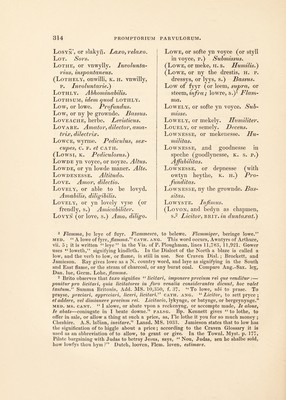
![Losyn’, or slakyn. Laxo, relaxo. Lot. Sors. Lothe, or vnwylly. Involunta- rius, inspontaneus. (Lothely, onwilli, k. h. vnwilly, p. Involuntarie.) Lotiily. Abhominabilis. Lothsum, idem quod lothly. Low, or lowe. Profundus. Low, or ny ]>e grownde. Passus. Loveache, herbe. Levisticus. Lovare. Amator, dilector, ama- trix, dilectrix. Lowce, wyrme. Pediculus, sex- cupes, c. f. et cath. (Lowsi, k. Pediculosus.) Lowde yn voyce, or noyze. Altus. Lowde, or yn lowde maner. Alte. Lowdenesse. Altitudo. Love. Amor, dilectio. Lovely, or able to be lovyd. Amabilis, diligibilis. Lovely, or yn lovely vyse (or frendly, s.) Amicabiliter. Lovyn (or love, s.) Amo, diligo. Lowe, or softe yn voyce (or styli in voyce, p.) Submissus. (Lowe, or meke, h. s. Humilis.) (Lowe, or ny the drestis, h. p. dressys, or lyys, s.) Bassus. Low of fyyr (or leem, supra, or steem, infra; lowre, s.)1 Flam- ma. Lowely, or softe yn voyce. Sub- misse. Lowely, or mekely. Humiliter. Louely, or semely. jDecens. Lownesse, or mekenesse. Hu- militas. Lownesse, and goodnesse in speche (goodlynesse, k. s. p.) Affabilitas. Lownesse, or depnesse (witli owtyn heythe, k. h.) Pro- funditas. Lownesse, ny the grownde. Pas- sitas. Lowyste. Infimus. (Lovon, and bedyn as cbapmen, s.2 Licitor, brit.in duntaxatd) 1 Flamma, pe leye of fuyr. Flammesco, to belewe. Flammiger, beringe lowe.” med. “ A lowe of fyre, flamma. cath. ang. This word occurs, Awntyrs of Arthure, vii. 5 ; it is written “leye” in the Vis. of P. Plougbman, lines 11,783, 11,921. Gower uses “loweth,” signifying kindletb. In tbe Dialect of the North a blaze is called a low, and the verb to low, or flame, is stili in use. See Craven Dial.; Brockett, and Jamieson. Ray gives lowe as a N. country word, and laye as signifying in the South and East flame, or the steam of charcoal, or any burnt coal. Compare Ang.-Sax. leg, Dan. lue, Germ. Lohe, flamma. 2 Brito observes that taxo signifies “ licitari, imponere precium rei que venditur :— jjonitur pro licitari, quia licitatores in foro venalia considerantes dicunt, hoc valet tantum.'1'' Summa Britonis, Add. MS. 10,350, f. 37. “ To lowe, ubi to prase. To prayse, preciari, appreciari, liceri, licitari.” cath. ang. “ Licitor, to sett pryce ; et addere, vel diminuere precium rei. Licitacio, lykynge, or batynge, or bergeynynge.” med. ms. cant. “ I alowe, or abate vpon a reckenyng, or accompte made, Ie aloue, Ie abats—coniugate in I beate downe.” palsg. Bp. Kennett gives “ to lothe, to offer in sale, or allow a thing at such a price, as, I’le lothe it you for so much money ; Cheshire. A.S. laftian, invitare.'' Lansd. MS. 1033. Jamieson states that to low has the signification of to higgle about a price; according to the Craven Glossary it is used as an abbreviation of to allow, to grant or give. In the Townl. Myst. p. 177, Pilate bargaining with Judas to betray Jesus, says, “ Nou, Judas, sen he shalbe sold, how lowfys thou hym?” Dutch, looven, Flem, loven, estimare.](https://iiif.wellcomecollection.org/image/b29331067_0001_0332.jp2/full/800%2C/0/default.jpg)