A manual of the physical diagnosis of thoracic diseases / by E. Darwin Hudson.
- Erasmus Darwin Hudson, Jr.
- Date:
- 1887
Licence: Public Domain Mark
Credit: A manual of the physical diagnosis of thoracic diseases / by E. Darwin Hudson. Source: Wellcome Collection.
Provider: This material has been provided by University of Bristol Library. The original may be consulted at University of Bristol Library.
154/176 page 136
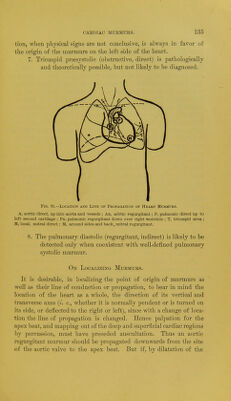
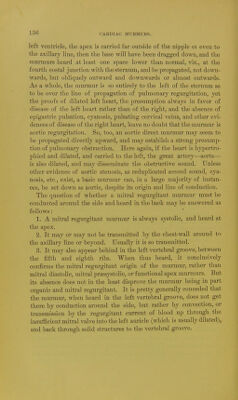
![left ventricle, the apex is carried far outside of the nipple oi even to the axillary line, then the base will have been dragged down, and the mnrmurs heard at least one space lower than normal, viz., at the fourth costal junction with the sternum, and be propagated, not down- wards, but obliquely outward and downwards or almost outwards. As a whole, the murmur is so entirely to the left of the sternum as to be over the hue of propagation of pulmonary regurgitation, yet the proofs of dilated left heart, the presumption always in favor of disease of the left heart rather than of the right, and the absence of epigastric pulsation, cyanosis, pulsating cervical veins, and other evi- dences of disease of the right heart, leave no doubt that the murmur is aortic regurgitation. So, too, an aortic direct murmur may seem to be propagated directly upward, and msLj establish a strong pi'esump- tion of pulmonary obstruction. Here again, if the heart is hypertro- phied and dilated, and carried to the left, the great artery—aorta— is also dilated, and may disseminate the obstructive sound. Unless other evidence of aortic stenosis, as reduplicated second sound, cya- nosis, etc., exist, a basic murmur can, in a large majority of instan- ces, be set down as aortic, des]3ite its origin and line of conduction. The question of whether a mitral regurgitant murmur must be conducted around the side and heard in the back may be answered as follows: 1. A mitral regurgitant murmur is always systolic, and heard at the apex. 2. It may or may not be transmitted by the chest-wall around to the axillary line or beyond. Usually it is so transmitted. 3. It may also appear behind in the left vertebral groove, between' the fifth and eighth ribs. When thus heard, it conclusively confirms the mitral regurgitant origin of the mm-mur, rather than mitral diastolic, mitral prsesystolic, or functional apex murmurs. But. its absence does not in the least disprove the murmur being in part organic and mitral regurgitant. It is pretty generally conceded that the murmur, when heard in the left vertebral groove, does not get there by conduction around the side, but rather by convection, or transmission by the regurgitant current of blood up through the insufficient mitral valve into the left auricle (which is usually dilated), and back through solid structures to the vertebral groove.](https://iiif.wellcomecollection.org/image/b2144447x_0154.jp2/full/800%2C/0/default.jpg)
 No text description is available for this image
 No text description is available for this image
 No text description is available for this image