A manual of the physical diagnosis of thoracic diseases / by E. Darwin Hudson.
- Erasmus Darwin Hudson, Jr.
- Date:
- 1887
Licence: Public Domain Mark
Credit: A manual of the physical diagnosis of thoracic diseases / by E. Darwin Hudson. Source: Wellcome Collection.
Provider: This material has been provided by University of Bristol Library. The original may be consulted at University of Bristol Library.
81/176 page 63
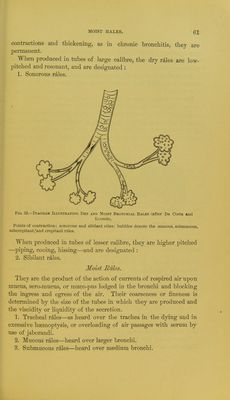
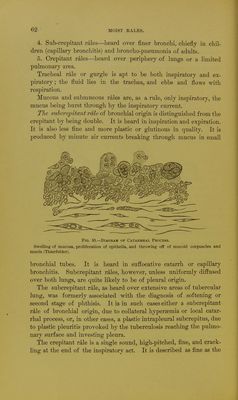
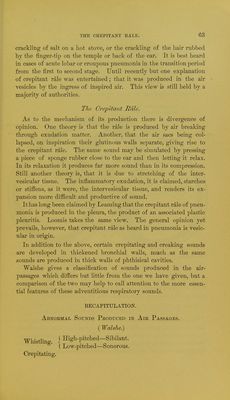
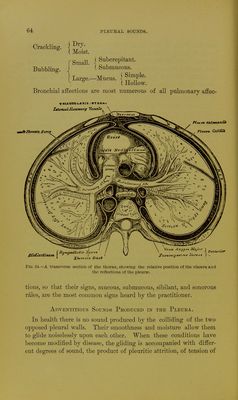
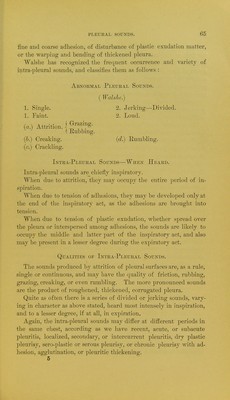
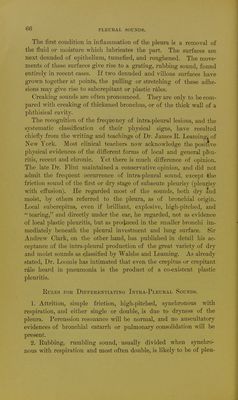
![crackling of salt on a hot stove, or the crackling of the hair rubbed by the finger-tip on the temple or back of the ear. It is best heard in cases of acute lobar or croupous pneumonia in the transition period from the first to second stage. Until recently but one explanation of crepitant rale was entertained; that it was ]Droduced in the air ' vesicles by the ingress of inspired air. This view is still held by a majority of authorities. The Crejpitant Rale. As to the mechanism of its production there is divergence of opinion. One theory is that the rale is produced by air breaking through exudation matter. Another, that the air sacs being col- lapsed, on inspiration their glutinous walls separate, giving rise to the crepitant rale. The same sound may be simulated by pressing a piece of sponge rubber close to the ear and then letting it relax. In its relaxation it produces far more sound than in its compression. Still another theory is, that it is due to stretching of the inter- vesicular tissue. The inflammatory exudation, it is claimed, starches or stiffens, as it were, the intervesicular tissue, and renders its ex- pansion more difficult and productive of sound. It has long been claimed by Learning that the crepitant rale of pneu- monia is produced in the pleura, the product of an associated plastic pleuritis. Loomis takes the same view. The general opinion yet prevails, however, that crepitant rale as heard in pneumonia is vesic- ular in origin. In addition to the above, certain crepitating and creaking sounds are developed in thickened bronchial walls, much as the same sounds are produced in thick walls of phthisical cavities. Walshe gives a classification of sounds produced in the air- passages which differs but little from the one we have given, but a compai'ison of the two may help to call attention to the more essen- tial features of these adventitious respu'atory sounds. RECAPITULATION. Abnormal Sounds Produced in Air Passages. {Walshe}) Whistling. { High-pitched-Sibilant. t Low-pitched—Sonorous. Crepitating.](https://iiif.wellcomecollection.org/image/b2144447x_0081.jp2/full/800%2C/0/default.jpg)
 No text description is available for this image
 No text description is available for this image
 No text description is available for this image