History; 1754-1904 : published in commemoration of the one hundred & fiftieth anniversary of the founding of King's College.
- Columbia University
- Date:
- 1904
Licence: In copyright
Credit: History; 1754-1904 : published in commemoration of the one hundred & fiftieth anniversary of the founding of King's College. Source: Wellcome Collection.
50/610 page 24
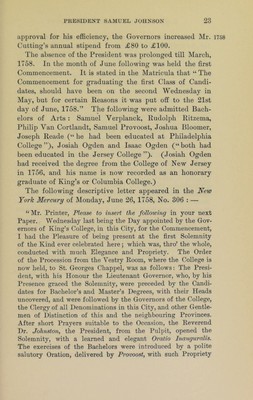
![1758 of Pronunciation, and so engaging an Air, as justly gain’d him the Admiration and Applause of all present. This was fol- lowed by a metaphysical Thesis, learnedly defended by Ritzema against Ver Planck and Cortlandt, with another held by Reed, and opposed by two Ogdens. The Bachelors Exercises were closed by a well-composed, genteel English Oration, on the Advantages of a liberal Education, delivered by Cortlandt, whose fine Address added a Beauty to the Sentiment, which gave universal Satisfaction to that numerous Assembly. After this, Mr. Treadicell, in a clear and concise Manner, demon- strated the Revolution of the Earth round the Sun, both from astronomical Observations, and the Theory of Gravity, and defended the Thesis against Mr. Cutting and Mr. Witmore, a candidate for the Degree of Master of Arts. This Dispute be- ing ended, the President descended from the Pulpit, and being seated in a chair, in a solemn Manner, conferred the Honours of the College upon those Pupils who were Candidates for a Bachelor’s Degree, and on several Gentlemen who had received Degrees in other Colleges. The Exercises were concluded with a Valedictory Oration [in Latin] by Mr. Cutting, universally esteemed a masterly Performance. The President then ad- dress’d himself in a solemn pathetick Exhortation, to the Bachelors, which could not fail of answering the most valuable Purposes, and leaving a lasting Impression on the Minds of all the Pupils. The whole Solemnity being finished, by a short Prayer, the Procession returned back to the City-Arms, where an elegant Entertainment was provided by the Governors of the College. This important Occasion drew together a numerous Assembly of People of all Orders, and it gave me a sincere Pleasure to see the Exercises performed in a Manner, which must reflect Honour upon the College and incite every Friend of his Country, to promote so useful, so well regulated an Institution.” At the same Commencement, the degree of Master of Arts was conferred upon thirteen gentlemen who had been educated elsewhere. There was no public Commencement for the class of 1759. Of the six candidates admitted in 1755, one “in his third year went to Philadelphia College,” one “about the middle of his second year went into the army,” one, “ after](https://iiif.wellcomecollection.org/image/b28990717_0050.jp2/full/800%2C/0/default.jpg)