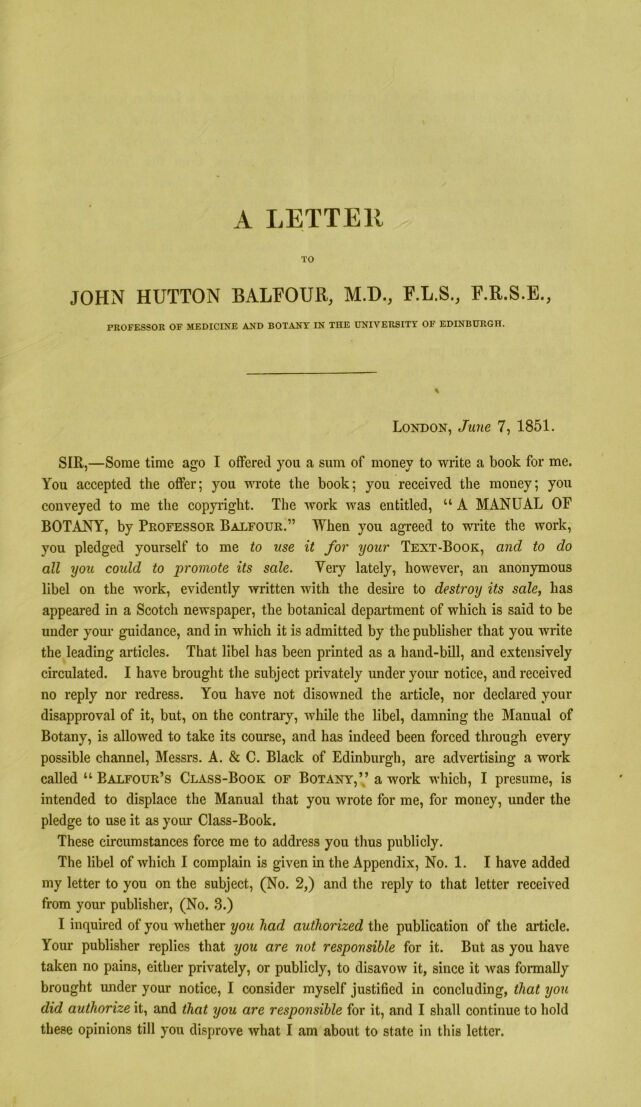
Licence: Public Domain Mark
Credit: Singular specimens of the Edinburgh practice of criticism. Source: Wellcome Collection.
Provider: This material has been provided by the Royal College of Physicians of Edinburgh. The original may be consulted at the Royal College of Physicians of Edinburgh.
25/32 page 25
![He knows, or lie ought to have known, before he summarily and superciliously condemned both me and my work, that the Manual is hona Jide, essentially and literally just the same as the first edition, previously praised by hiin, but minus the mistakes of that edition. It is not, nor does it profess to be, an edition with addi- tions and emendations, it is a mere reprint of the original, deducting the en*ors, which a careful perusal and revisal of the book and of the press discovered and c:m— celled. If there are any blunders in the Avork, they have not been “ brought together bv other hands,” as it is Avickedly and fooUshly affirmed; but thej are such as were originallv inherent in it, and of which, except by vague indefinite accusation, our critic does not indicate so much as one^ If the Professor s well-merited reputation is in jeopardy the fault is his OAvn. I made no additions, amendments, noi alterations AvhatCA'er but such as Avere necessary to render the Avoik as coriect and as consistent with itself as possible. The distortion complained of, consecjuently, cannot be in this portion of the Professor’s Avritings, but rather in the moral optics of the individual who has looked Avith an eA-il eve on my unpleasant task of rectifying so many blun- ders and inconsistencies. I 'should indeed have reason to sympathize with the votaries of science in general, and Avith the promoters of Botany in particular, for Avith many of the latter I have long been intimately and agreeably connected, if the Professor of Botany in 0!ie of Scotland’s most famed universities had the least'con- nection Avith the stupid farrago of blunders and abuse which the reAuewer has pub- lished in your journal. I am. Sir, Your obedient Servant, THE EDITOR. No. 16. Specimens of the 409 Errors contained in the First edition of Professor Balfour's Manual of Botany^ and corrected in the Second edition. Bad English.—P. 52, The composition of the vascular bundles, in different parts of their course, vary. P. 110, The tissues into the composition of AA'hich these proteine compounds enter, is tinged, &c. P. 144, Beet-root and white turnips contains only 3 per cent. P. 196, A Filiform filament. Mistakes in Proper names.—Meyer for Meyen; Goethe, and sometimes Goethe, for Goethe ; Micham for Mitcham. Mistakes in Latin.—P. \2.,fssum for fissus;'in p. 74, fidus for fissus. In above a dozen places, Latin verbs are quoted in the fii'st person of the indicative mood, and the English translation is given in the infinitive, making, for example, to bear to be equivalent to 1 bear. Mistakes in Greek.—As in the Latin, so in the Greek, the English is put in the infinitive, and the Greek in the indicative, mood. There ai*e above 30 eiTors of this sort. At p. 163, we are told that signifies a ring, and at p. 594, that iu? signifies drawn. They give these words other meanings at Oxford and Cambridge, and those meanings have been put into the Second Edition. These, perhaps, are the changes Avhich struck the revieAver as being “ of a sufficiently odd and remarkable character.” Errors in Matters of Fact.—P. 354, Henslow gives the folloAving analysis of these sub-orders, Avith the number of British genera in each—[read species.~\ P. 269, “ While the fruit enlarges, the sap is drawn towards it, and a great exhaustion of its juices takes place.” [Of course, by the time the fruit is ripe, it Avill be totally exhausted of its juices.] P. 149, Reseda Luteola is interpreted to signify Woad, and is classed among plants that yield yellow colouring matters. I take leave to state that Woad is a blue dye, and that it is derived from the hatis tinctoria of Linnaeus, a plant Avhich, under that name at least, is not to be found in the Manual. It is not even named among the plants that jield blue dyes. On the contrary, the yellow colouring matter derived from Reseda Luteola, is not Woad but Weld. Professor Balfour is said to admit his responsibility for the First Edition of his Manual, but not for the Second Edition. As the latter differs from the former merely by the absence of these 409 en’ors, perhaps he Avould like to see them printed as an Appendix to the Second Edition, to complete it, and restore his responsibility.](https://iiif.wellcomecollection.org/image/b28044009_0027.jp2/full/800%2C/0/default.jpg)