Anatomy, descriptive and surgical / by Henry Gray ; the drawings by H.V. Carter ; with additional drawings in later editions.
- Henry Gray
- Date:
- 1893
Licence: Public Domain Mark
Credit: Anatomy, descriptive and surgical / by Henry Gray ; the drawings by H.V. Carter ; with additional drawings in later editions. Source: Wellcome Collection.
48/1178 page 2
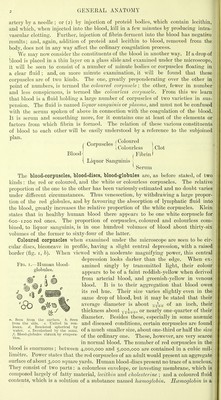
![artery by a needle; or (2) by injection of proteid bodies, which contain lecithin, and which, when injected into the blood, kill in a few minutes by producing intra- vascular clotting. Further, injection of fibrin-ferment into the blood has negative results; and, again, addition of proteid and lecithin to blood, removed from the body, does not in any way affect the ordinary coagulation process. We may now consider the constituents of the blood in another way. If a drop of blood is placed in a thin layer on a glass slide and examined under the microscope, it will be seen to consist of a number of minute bodies or corpuscles floating in a clear fluid ; and, on more minute examination, it will be found that these corpuscles are of two kinds. The one, greatly preponderating over the other in point of numbers, is termed the coloured corjniscle; the other, fewer in number and less conspicuous, is termed the colourless corjmscle. From this we learn that blood is a fluid holding a large number of corpuscles of two varieties in sus- pension. The fluid is named liqtior sanguinis ov plasma, and must not be confused with the serum spoken of above in connection with the coagulation of the blood. It is serum and something more, for it contains one at least of the elements or factors from which fibrin is formed. The relation of these various constituents of blood to each other will be easily understood by a reference to the subjoined p T [Coloured x (Colourless [Clot Blood j I Fibrin i y Liquor Sanguinis -1 ^ Serum The blood-corpuscles, blood-discs, blood-globules are, as before stated, of two kinds : the red or coloured, and the white or colourless corpuscles. The relative proportion of the one to the other has been variously estimated and no doubt varies under different circumstances. Thus venesection, by withdrawing a large propor- tion of the red globules, and by favouring the absorption of lymphatic fluid into the blood, greatly increases the relative proportion of the white corpuscles. Klein states that in healthy human blood there appears to be one white corpuscle for 600-1200 red ones. The proportion of corpuscles, coloured and colourless com- bined, to liquor sanguinis, is in one hundred volumes of blood about thirty-six volumes of the former to sixty-four of the latter. Coloured corpuscles when examined under the microscope are seen to be cir- cular discs, biconcave in profile, having a slight central depression, with a raised border (fig. i, h). When viewed with a moderate magnifying power, this central de]3ression looks darker than the edge. When ex- FiG. I.—Human blood- amined singly by transmitted light, their colour Tlobules. appears to be of a faint reddish-yellow when derived from arterial blood, and greenish-yellow in venous blood. It is to their aggregation that blood owes its red hue. Their size varies slightly even in the same drop of blood, but it may be stated that their average diameter is about 3^0 inch, their thickness about ^^-hoo^ ^r nearly one-quarter of their a . , ,0 diameter. Besides these, especially in some anaemic a. Seen from the surface, o. Seen . . , . from the side. c. United in rou- and diseased couditions, Certain corpuscles are found leaux. d. Rendered splierical by „ , . , , n • t ^ ^^' l^ water, e. Decolorised bv the same, ot a much Smaller size, aoout one-third or hail the size /.^Blood-globules shrunkby evapora- ^^1^ ordinary One. These, however, are very scarce in normal blood. The number of red corpuscles in the blood is enormous; between 4,000,000 and 5,000,000 are contained in a cubic mil- limetre. Power states that the red corpuscles of an adult would present an aggregate surface of about 3,000 square yards. Human blood-discs present no trace of a nucleus. They consist of two parts : a colourless envelope, or investing membrane, which is composed largely of fatty material, lecithin and cholesterine ; and a coloured fluid contents, which is a solution of a substance named licemoglohin. Hcemoglohin is a](https://iiif.wellcomecollection.org/image/b20402934_0048.jp2/full/800%2C/0/default.jpg)