Anatomy, descriptive and surgical / by Henry Gray ; the drawings by H.V. Carter ; with additional drawings in later editions.
- Henry Gray
- Date:
- 1893
Licence: Public Domain Mark
Credit: Anatomy, descriptive and surgical / by Henry Gray ; the drawings by H.V. Carter ; with additional drawings in later editions. Source: Wellcome Collection.
83/1178 page 37
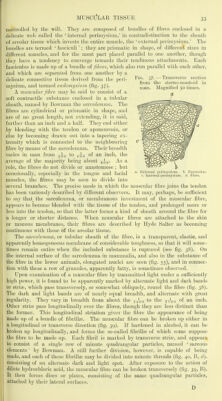
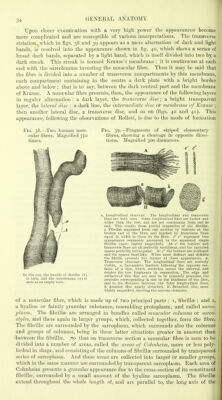
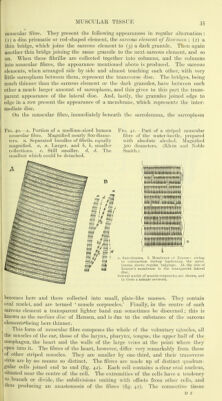
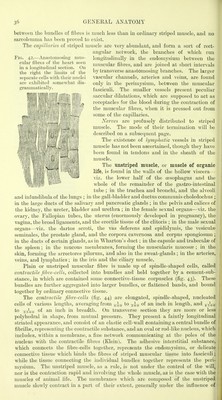
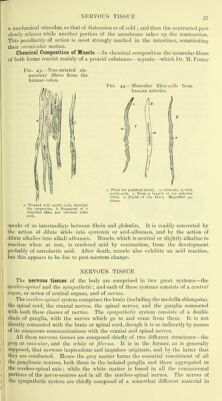
![a mechanical stimulus, as that of distension or of cold ; and then the contracted part slowly relaxes while another portion of the membrane takes up the contraction. This peculiarity of action is most strongly marked in the intestines, constituting their vermicular motion. Chemical Composition of Muscle.—In chemical composition the muscular fibres of both forms consist mainly of a proteid substance—myosin—which Dr. M. Foster Fig. 43.—-Non-striated ele- mentary fibres from the human colon. Fig. 44.—Muscular fibre-cells fi-om human arteries. I. From the popliteal artery, a, without; b, with acetic acid. 2. From a ioranch of the anterior tibial, a. Nuclei of the fibres. Magnified 350 times. a. Treated with acetic acid, showing the corpuscles, b. Fragment of a detached fibre, not touched with acid. speaks of as intermediate between fibrin and globulin. It is readily converted by the action of dilute acids into syntonin or acid-albumen, and by the action of dilute alkalies into alkali-albumen. Muscle, which is neutral or slightly alkaline in reaction when at rest, is rendered acid by contraction, from the development probably of sarcolactic acid. After death, muscle also exhibits an acid reaction, but this appears to be due to post-mortem change. NERVOUS TISSUE The nervous tissues of the body are comprised in two great systems—the cerehro-spinal and the synvpathetic ; and each of these systems consists of a central organ, or series of central organs, and of nerves. The cerebrospinal system comprises the brain (including the medulla oblongata), the spinal cord, the cranial nerves, the spinal nerves, and the ganglia connected with both these classes of nerves. The sympathetic system consists of a double chain of ganglia, with the nerves which go to and come from them. It is not directly connected with the brain or spinal cord, though it is so indirectly by means of its numerous communications with the cranial and spinal nerves. All these nervous tissues are composed chiefly of two different structures—the grey or vesicular, and the ivhite or fibrous. It is in the former, as is generally supposed, that nervous impressions and impulses originate, and by the latter that they are conducted. Hence the grey matter forms the essential constituent of all the ganglionic centres, both those in the isolated ganglia and those aggregated in the cerebro-spinal axis; while the w^hite matter is found in all the commissural portions of the nerve-centres and in all the cerebro-S]3inal nerves. The nerves of the sympathetic system are chiefly composed of a somewhat different material in](https://iiif.wellcomecollection.org/image/b20402934_0083.jp2/full/800%2C/0/default.jpg)