Chemical examination of jalap / by Frederick B. Power and Harold Rogerson.
- Frederick Belding Power
- Date:
- [1910]
Licence: Attribution 4.0 International (CC BY 4.0)
Credit: Chemical examination of jalap / by Frederick B. Power and Harold Rogerson. Source: Wellcome Collection.
Provider: This material has been provided by The Royal College of Surgeons of England. The original may be consulted at The Royal College of Surgeons of England.
4/38
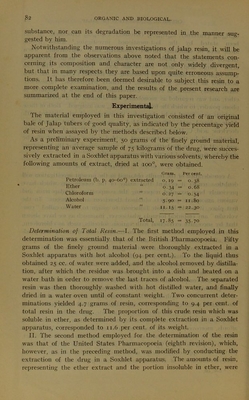
![[Reprinted from The Jounral of the American Chemical Society. Vol. XXXII. No. i. January, 1910.] [Contribution from the Wellcome Chemical Research Laboratories, London ] CHEMICAL EXAMINATION OF JALAP.1 By Frederick. B. Power and Harold Rogerson. Received November 8, 1909. Under the title of Jalapa (Jalap) the various national Pharmacopoeias recognize the dried tuberous root of Exogonium purga, Bentham (Ipomoea purga, Hayne). The only constituent of the tuber possessing chemical interest is the resin, which is largely used medicinally. This resin (Resina Jalapae of the Pharmacopoeias), like many similar products obtained from plants belonging to the family of Convolvulaceae, is of a glucosidic nature. It has been the subject of numerous chemical investigations during the past century, and the literature relating thereto is therefore considerable in extent. A review of the more important of these publi- cations has been given by Hoehnel2 in connection with an investigation entitled “Ueber das Convolvulin, das Glycosid der Tubera Jalapae (Ipomoea purga, Hayne).” A quite complete account of this subject and of other closely related so-called glucoside resins, together with cita- tions of the literature, have also been recorded by van Rijn (‘‘Die Glyko- side,” Berlin, 1900), and by Tschirch (‘‘Die Harze,” Bd. II, Leipzig, 1906). It would not be expedient in this place to consider in detail the various statements of earlier investigators respecting the composition of jalap resin or the products obtained therefrom, especially as many of these statements are not only conflicting, but are evidently based upon incor- rect observations and deductions. In order, however, to indicate the unsatisfactory state of present knowledge respecting the chemical charac- ters of this resin, a brief exposition of the subject may be given. The chief portion of jalap resin, which is insoluble in ether and com- monly designated as “convolvulin,”3 although a completely amorphous product, has at various times been assigned the following empirical for- mulas: C31H50O10 (Mayer); C21H35O10 (Kayser); C24H40O12 (Laurent); 1 Communicated, in abstract, to the International Congress of Applied Chemistry, London, June 1, 1909. Presented at the meeting of the New York Section of the American Chemical Society, October 30, 1909. 2 Arch. Pharm., 234, 647 (1896). 3 In English pharmacy the portion of jalap resin which is insoluble in ether is still frequently designated by the original and more appropriate name of “jalapin.” The latter term, however, is now more commonly employed to denote the resin of scam- mony and of Mexican Male jalap (Ipomoea orizabensis, Ledanois), both of which are completely soluble in ether.](https://iiif.wellcomecollection.org/image/b22425561_0006.jp2/full/800%2C/0/default.jpg)