Annual report of the Medical College of Bengal : fourteenth year, session 1848-49 / under the immediate control and superintendence of the Council of Education.
- Medical College of Bengal
- Date:
- 1849
Licence: Public Domain Mark
Credit: Annual report of the Medical College of Bengal : fourteenth year, session 1848-49 / under the immediate control and superintendence of the Council of Education. Source: Wellcome Collection.
Provider: This material has been provided by Royal College of Physicians, London. The original may be consulted at Royal College of Physicians, London.
66/102 page 28
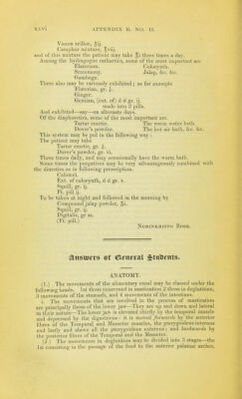
![by the simple follicles of the stomach. This fluid consists of a ])eciiliar organic substance called the pepsiiie, and a free acid which has been found by the chemical analysis of Dunglison, Prout and Beaumont to be hydro- chloric acid in the ease of the human gastric juice. In the stomach the food is changed into chyme. (3.) In the duodenum the chyme is principally acted upon by the pancreatic juice and the bile. What changes each of these eifects in the food are not well understood. This much is known that they, especially the bile, are essential to the elaboi-ation of the chyle. It has been founil by experiment that when the bile-duct, the ductus choledochus, of an ani- mal is tied and a hole bored through its abdominal parietes for the passage of the bile out of the body, it dies of inanition, in the same space of time in which it would breathe its last had it not been provided with any food whatever. In the rest of the intestines, the food is mixed with the vari- ous secretions that are poured forth by the Beyer's glands (solitariae and agminata;), Lieburkiilms follicles, and the solitary flask, shaped glands of the large intestine. Nothing certain is known with regard to the changes that these fluids eff'eet in the food. (2.) The Blood consists of a solid and a fluid portion. The solid part is made up of the red and colourless or lymph corpuscules, and the fluid of the liquor sanguinis. The latter consists of serum having fibrin dis- solved in it. The following table shows the composition of the blood in one view. The blood-corpuscules are disc-shaped bodies which are depressed in the middle on either surface. They are oval in the fishes, reptiles and amphibia, and in the mammalia including man (excepting the camelidae) circular. In the invertebrata, excepting the annelidae, they are colowless while in the higher classes of animals they are red. They ai-e nucleated, but in the red globules of man no nucleus has been yet discovered. Their .structure generally speaking is this—most externally an evelope, inter- nally a nucleus and between these two the colouring substance which con- sists of 2 parts viz. Hamatine or Hamatosine, and Glohuline. (3.) The spermatic cord is supplied with nerves derived from the sper- matic plexus and the ilio-inguinal branch of the Lumbar plexus. The nerves of the scrotum are supplied by the genito-crural and ilio-inguinal branches of the lumbar plexus and by the superficial perineal branch of the internal pudic and some branches of the Lesser Ischiatic. The inter- nal pudic and the Lesser Ischiatic nerves are derived from the sacral plexus. (4.) The membranous part of the urethra is composed of mucous membrane internally and fibrous membrane externally ? no erectile tissue enters into its structure. It intervenes between the prostatic and the bulbous portion of the urethra. It is less than an inch in length. It has above it the sub-pubUc ligament and anteriorly and at the sides, Cowper's glands. It is embraced on all sides by the compressores urethra muscles, which arise each of them bv a tendinous point from the ramus of the Pubis and split at its sides into 2 slips one of which passes above and the other below it and thus enclose it. This portion of the urethar perforates the triangular ligament. Blood cras- CllUNUKR C'OOMAR DeY.](https://iiif.wellcomecollection.org/image/b24766823_0066.jp2/full/800%2C/0/default.jpg)