Metallographia: or, an history of metals. Wherein is declared the signs of ores and minerals both before and after digging, the causes and manner of their generations, their kinds, sorts and differences; with the description of sundry new metals, or semi metals, and many other things pertaining to mineral knowledge. As also, the handling and shewing of their vegetability, and the discussion of the most difficult questions belonging to mystical chymistry, as of the philosophers gold, their mercury, the liquor alkahest, aurum potabile, and such like / Gathered forth of the most approved authors that have written in Greek, Latine, or High-Dutch; with some observations and discoveries of the author himself. By John Webster.
- John Webster
- Date:
- 1671
Licence: Public Domain Mark
Credit: Metallographia: or, an history of metals. Wherein is declared the signs of ores and minerals both before and after digging, the causes and manner of their generations, their kinds, sorts and differences; with the description of sundry new metals, or semi metals, and many other things pertaining to mineral knowledge. As also, the handling and shewing of their vegetability, and the discussion of the most difficult questions belonging to mystical chymistry, as of the philosophers gold, their mercury, the liquor alkahest, aurum potabile, and such like / Gathered forth of the most approved authors that have written in Greek, Latine, or High-Dutch; with some observations and discoveries of the author himself. By John Webster. Source: Wellcome Collection.
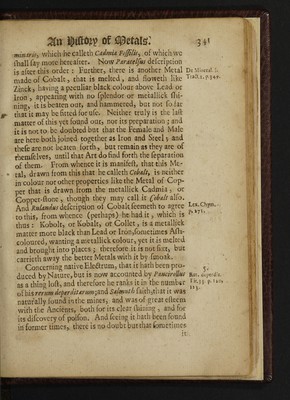
![r Zn of petals, 34* mma.ru-, which he calleth Cadmk Pojjilis^ of which wc [hall fay more hereafter. Now Paracelfus defcription is after this order: Further, there is another Metal DsMineral.!, made of Cobalt, that is melted, and floweth like Ttaa.i. p.3^9. Ztnck, having a peculiar black colour above Lead or Iron , appearing with no fplendor or metal] ick fhi- nnw, it is beaten out, and hammered, but not fo far that it may be fitted for ufe. Neither truly is the lad matter of this yet found out, nor its preparation; and ic is not to be doubted but that the Femaleand Male are here both joined together as Iron and Steel 5 and thefe are not beaten forth, but remain as they are of themfelves, until that Art do find forth the feparation of them. From whence it is manifeft, that this Me¬ tal, drawn from this that he calleth Cobalt, is neither in colour nor other properties like the Metal of Cop¬ per that is drawn from the metallick Cadmia, or Copper-ftone , though they may call it fibalt alfo. And Rulandus defcription of Cobalt feemeth to agree Lcx.Chym. .. to this, from whence (perhaps) he had it, which is p'17 ' thus : Kobolt, or Kobalt, or Collet, is a metallick matter more black than Lead or Iron,fometimes Afh- eoloured, wanting a metallick colour, yet it.is melted and brought into places; therefore it is not fixt, but carrieth away the better Metals with it by fmoak. Concerning native Ele&rum, that it hath been pro- . 5; duced by Nature, but is now accounted by PttnciroUus Rer. lUperd;?, as a thing loft, and therefore he ranks it in the number Jmj- P-1 othisrerimdeperdiurum;an&Salm&thhithjhaiii was 3' natur ally found in the mines; and was of great efteem with the Ancients, both for its clear (Lining , and for its difcovery of poifon. And feeing it hath been found in former times,, there is no doubt but that fometimes A it 1](https://iiif.wellcomecollection.org/image/b3032399x_0369.jp2/full/800%2C/0/default.jpg)