Cellular pathology as based upon physiological and pathological histology : twenty lectures delivered in the Pathological Institute of Berlin / by Rudolf Virchow, translated from the German by Frank Chance.
- Rudolf Virchow
- Date:
- 1859
Licence: Public Domain Mark
Credit: Cellular pathology as based upon physiological and pathological histology : twenty lectures delivered in the Pathological Institute of Berlin / by Rudolf Virchow, translated from the German by Frank Chance. Source: Wellcome Collection.
Provider: This material has been provided by the Woodruff Health Sciences Center Library at Emory University, through the Medical Heritage Library. The original may be consulted at the Woodruff Health Sciences Center Library, Emory University.
28/570
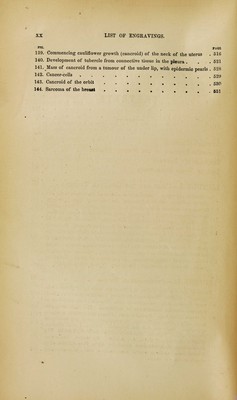
![CONTENTS »4W Author's Preface . . . . • • » v Author's Preface to the Second Edition . . xi Translator's Preface . . . . . . . xiii List of Wood Engravings . . . . • . xv LECTURE I.—Cells and the Cellular Theory . 27 Introduction and object. Importance of anatomical discoveries in the his- tory of medicine. Slight influence of the cell-theory upon pathology. Cells as the ultimate active elements of the living body. Their nature more accurately defined. Vegetable cells ; membrane, contents, nucleus. Animal cells; capsulated (cartilage) and simple. Nuclei of. Nucleoli of. Theory of the formation of cells out of free cytoblastema. Constancy of nucleus and its importance in the maintenance of the living cell. Di- versity of cell-contents and their importance as regards the functions of parts. Cells as vital unities. The body as a social organization. Cellu- lar in contradistinction to humoral and solidistic, pathology.—Explana- tion of some of the preparations. Young shoots of plants. Growth of plants. Growth of cartilage. Young ova. Young cells in sputa. LECTURE II.—Physiological Tissues . . . .51 Falsity of the view that tissues and fibres are made up of globules (ele- mentary granules). The investment theory (Umhullungstheorie). Equi- vocal [spontaneous] generation of cells. The law of continuous deve- lopment.—General classification of the tissues. The three categories of General Histology. Special tissues. Organs and systems, or appara- tuses.—The Epithelial Tissues. Squamous, cylindrical, and transitional epithelium. Epidermis and rete Malpighii. Nails, and their diseases. Crystalline lens. Pigment. Gland-cells.—The Connective Tissues. The theories of Schwann, Henle, and Reichert. My theory. Connective tissue as intercellular substance. Cartilage (hyaline, fibro- and reticular). Mucous tissue. Adipose tissue. Anastomosis of cells ; juice-conveying system of tubes or canals.](https://iiif.wellcomecollection.org/image/b21037085_0028.jp2/full/800%2C/0/default.jpg)