A history of the mathematical theory of probability from the time of Pascal to that of Laplace / by I. Todhunter.
- Isaac Todhunter
- Date:
- 1865
Licence: Public Domain Mark
Credit: A history of the mathematical theory of probability from the time of Pascal to that of Laplace / by I. Todhunter. Source: Wellcome Collection.
545/648 (page 525)
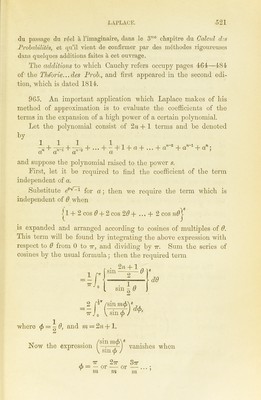
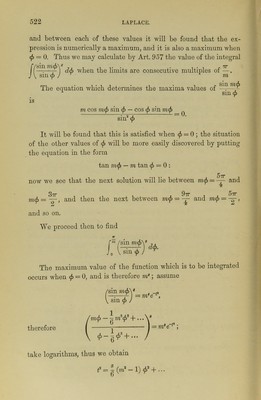
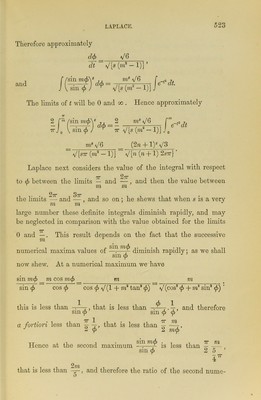
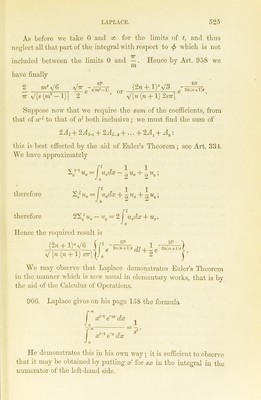
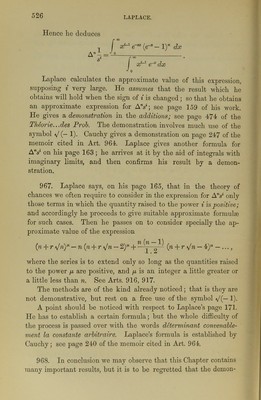
![As before we take 0 and go for the limits of t, and thus neglect all that part of the integral with respect to </> which is not 7T included between the limits 0 and —. Hence by Art. 958 we m have finally 2 ms\/6 (2n + l)V3 7r — 1)} 2 5 \/{w (w + 1) 2s7t} Suppose now that we require the sum of the coefficients, from that of crl to that of a1 both inclusive ; we must find the sum of 2Ai + 2Ai_x + 2Aj_2 + ... + 2At 4- A0: this is best effected by the aid of Euler’s Theorem; see Art. 334. We have approximately ri ii u* = / u*dx -9ux+ 9 % ; ZJ ux =J uJLx + | u„ + | u0; therefore therefore 2S0* ux - u0 =2 f uxdx + ux. J 0 Hence the required result is +i}y dfh-gfegj+i ■Tsfegi V lw (w+ 1) S7T] (J0 2 We may observe that Laplace demonstrates Euler’s Theorem in the manner which is now usual in elementary works, that is by the aid of the Calculus of Operations. 9G6. Laplace gives on his page 158 the formula He demonstrates this in his own way; it is sufficient to observe that it may be obtained by putting x for sx in the integral in the numerator of the left-hand side.](https://iiif.wellcomecollection.org/image/b24863026_0545.jp2/full/800%2C/0/default.jpg)