A history of the mathematical theory of probability from the time of Pascal to that of Laplace / by I. Todhunter.
- Isaac Todhunter
- Date:
- 1865
Licence: Public Domain Mark
Credit: A history of the mathematical theory of probability from the time of Pascal to that of Laplace / by I. Todhunter. Source: Wellcome Collection.
588/648 (page 568)
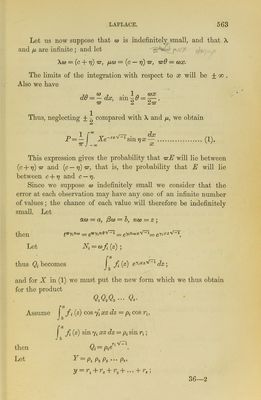
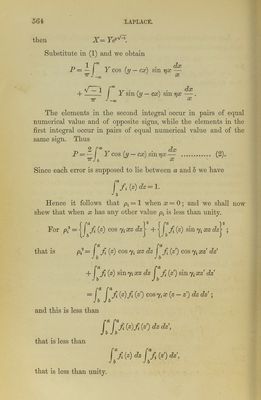
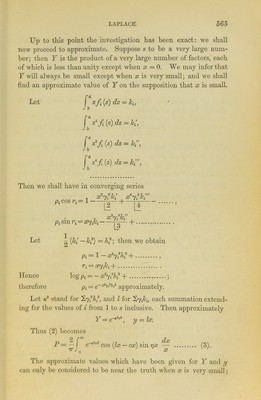
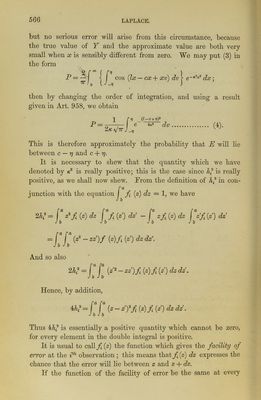
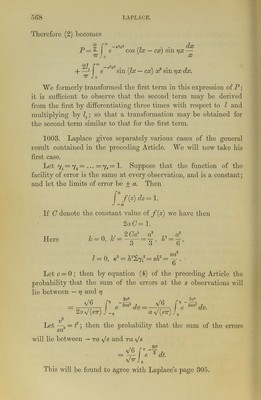
![Therefore (2) becomes 77 2 r go I n . . dx P=*- e cos [lx — cx) sm 7]x —- 7T J 0 X +?ir -K2X2 . ,7 v e sm [lx — cx) x2 sin rjx dx. 7T Jo We formerly transformed the first term in this expression of P; it is sufficient to observe that the second term may be derived from the first by differentiating three times with respect to l and multiplying by \; so that a transformation may be obtained for the second term similar to that for the first term. 1003. Laplace gives separately various cases of the general result contained in the preceding Article. We will now take his first case. Let 7j = 72= ... =7*= 1. Suppose that the function of the facility of error is the same at every observation, and is a constant; and let the limits of error be + a. Then If C denote the constant value of f(z) we have then 2aC= 1. Here Jc = 0, Jc = 2 CP 3 1 = 0, P = ldt^=sP = sa 6 ‘ Let c = 0 ; then by equation (4) of the preceding Article the probability that the sum of the errors at the s observations will lie between — 77 and rj a/6 2a a/(sir) J -v v 3v2 2sa2 dv V6 a V (s7r) v - 3v0- 2 sa,'2 dv. v Let —-2 = f; then the probability that the sum of the errors SCI/ will lie between — ra \/s and tci T — e 3£ 2 dt. = VG[t V77 J 0' This will be found to agree with Laplace’s page 305.](https://iiif.wellcomecollection.org/image/b24863026_0588.jp2/full/800%2C/0/default.jpg)