A history of the mathematical theory of probability from the time of Pascal to that of Laplace / by I. Todhunter.
- Isaac Todhunter
- Date:
- 1865
Licence: Public Domain Mark
Credit: A history of the mathematical theory of probability from the time of Pascal to that of Laplace / by I. Todhunter. Source: Wellcome Collection.
600/648 (page 580)
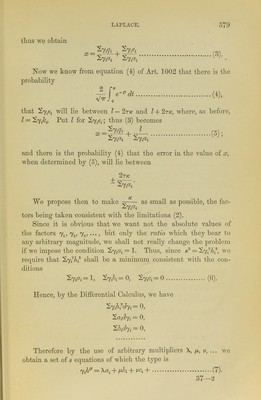
![Let j\ stand for 1 then from (7) we can deduce the follow- ing system of equations: 1 = + vtaiCiji + • • •' 0 = Xtafiji + /jSbfji + vXbiCiji + ... 0 = XtciiCiji + fjbtbicji + vtciji + ... (8). To obtain the first of equations (8) we multiply (7) by aji, and then sum for all values of i paying regard to (6) ; to ob- tain the second of equations (8) we multiply (7) by bji and sum; to obtain the third of equations (8) we multiply (7) by cji and sum; and so on. The number of equations (8) will thus be the same as the number of conditions in (6), and therefore the same as the number of arbitrary multipliers \ /x, v, ... Thus equations (8) will determine \ [x, v, ... \ and then from (5) we have x = tviZi + l (9)- We shall now shew how this value of x may practically be best calculated. Take s equations of which the type is ciiX + bitf + CiZ + = + /q. First multiply by aiji and sum for all values of i; then mul- tiply by bji and sum; then multiply by cj] and sum; and so on: thus we obtain the following system xtafji + y'tafiiji + z'tafiijt + • • • = t (ji + k) adi xXciibJi + y’tbiji + zXbiCiji + ... = 2 (g« + &() bji ^ xXafiji + y'tbiCiji, + z’tciji + ... =t (qi + h) cji (10). Now we shall shew that if x be deduced from (10) we shall have x = Sy+ l, and therefore x = x. For multiply equations (10) in order by A, fx, v, ... and add; then by (8)](https://iiif.wellcomecollection.org/image/b24863026_0600.jp2/full/800%2C/0/default.jpg)