Cursory remarks on some parts of a work, entitled Studies of nature ; originally written by M. de Saint Pierre, and translated into English by ... Henry Hunter / [William Cole].
- Cole, William, active 1807.
- Date:
- 1807
Licence: Public Domain Mark
Credit: Cursory remarks on some parts of a work, entitled Studies of nature ; originally written by M. de Saint Pierre, and translated into English by ... Henry Hunter / [William Cole]. Source: Wellcome Collection.
22/80 (page 12)
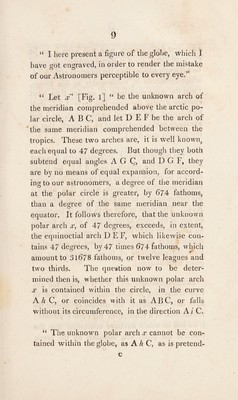
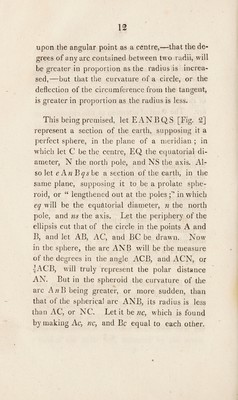
![upon the angular point as a centre,—that the de¬ grees of any arc contained between two radii, will be greater in proportion as the radius is increa¬ sed,—but that the curvature of a circle, or the deflection of the circumference from the tangent, is greater in proportion as the radius is less. This being premised, letEANBQS [Fig. 2] represent a section of the earth, supposing it a perfect sphere, in the plane of a meridian ; in which let C be the centre, EQ the equatorial di¬ ameter, N the north pole, and NS the axis. Al¬ so let e An be a section of the earth, in the same plane, supposing it to be a prolate sphe¬ roid, or “ lengthened out at the polesin which eq will be the equatorial diameter, n the north pole, and ns the axis. Let the periphery of the ellipsis cut that of the circle in the points A and B, and let AB, AC, and BC be drawn. Now in the sphere, the arc ANB will be the measure of the degrees in the angle ACB, and x\CN, or IACB, will truly represent the polar distance AN. But in the spheroid the curvature of the arc AnB being greater, or more sudden, than that of the spherical arc ANB, its radius is less than AC, or NC. Let it be nc, which is found by making Ac, nc, and Be equal to each other. ♦](https://iiif.wellcomecollection.org/image/b30369332_0022.jp2/full/800%2C/0/default.jpg)