The physician's prescription book : containing lists of terms, phrases, contractions and abbreviations, used in prescriptions, with explanatory notes : also the grammatical construction of prescriptions, etc., etc. : to which is added a key, containing the prescriptions in an unabbreviated form with a literal translation : for the use of medical and pharmaceutical students.
- Jonathan Pereira
- Date:
- 1852
Licence: Public Domain Mark
Credit: The physician's prescription book : containing lists of terms, phrases, contractions and abbreviations, used in prescriptions, with explanatory notes : also the grammatical construction of prescriptions, etc., etc. : to which is added a key, containing the prescriptions in an unabbreviated form with a literal translation : for the use of medical and pharmaceutical students. Source: Wellcome Collection.
Provider: This material has been provided by the National Library of Medicine (U.S.), through the Medical Heritage Library. The original may be consulted at the National Library of Medicine (U.S.)
121/292
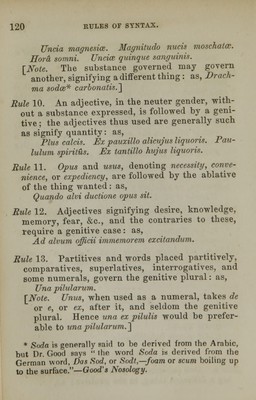
![Fiant pilulce. duodecim, quce sumendce sunt u antra. Rule G. But if a nominative come between the re- lative and the verb, the relative shall be of that case which the verb or noun following, or the preposition going before, uses to govern : as, Fiat haustus, cut, tempore capiendi, adde, fyc. [Note. Here the nominative (tu, understood) comes between the relative (cut) and the verb (adde): hence the relative is put in the dative case, being governed by the verb adde.] Rule 7. Two or more substantives singular, coupled together by a conjunction, generally have a verb, adjective, or relative plural: as, Haustus et pilula sumantur tribus horis. Rule 8. One substantive agrees with another, sig- nifying the same thing, in case: as, Recipe, Fotassoe tartratis (vulgo Tartari solubilis) unciam. [Note. Potassai tartras and Tartarum solubile being terms signifying the same thing, they are put in the same case.] II. Of Government. 1. Of Nouns. 2. Of Verbs. 3. Of words indeclinable. Nouns. Rule 9. One substantive governs another, signify- ing a different thing, in the genitive : as,](https://iiif.wellcomecollection.org/image/b21146858_0121.jp2/full/800%2C/0/default.jpg)