The physician's prescription book : containing lists of terms, phrases, contractions and abbreviations, used in prescriptions, with explanatory notes : also the grammatical construction of prescriptions, etc., etc. : to which is added a key, containing the prescriptions in an unabbreviated form with a literal translation : for the use of medical and pharmaceutical students.
- Jonathan Pereira
- Date:
- 1852
Licence: Public Domain Mark
Credit: The physician's prescription book : containing lists of terms, phrases, contractions and abbreviations, used in prescriptions, with explanatory notes : also the grammatical construction of prescriptions, etc., etc. : to which is added a key, containing the prescriptions in an unabbreviated form with a literal translation : for the use of medical and pharmaceutical students. Source: Wellcome Collection.
Provider: This material has been provided by the National Library of Medicine (U.S.), through the Medical Heritage Library. The original may be consulted at the National Library of Medicine (U.S.)
46/292
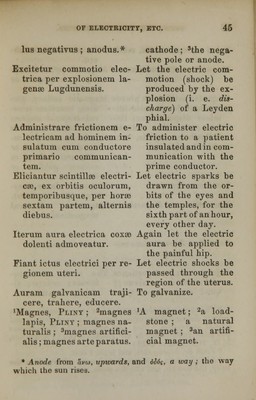
![tricity'] by sparks [or by shocks]. Scintillas elicere, educere. To draw sparks (from the body). Scintillas admovere. To give (or communi- cate) sparks. Electricitas voltaica (galva- Voltaic (galvanic _ or nica vel animalis). Vol- animal) electricity, taismus; Galvanismus. Voltaism or Galvan- (Electricitas mctallica ; ism. (Metallic elec- irritamcntummctallicum'.l) tricity, i. e. electricity of metals, or the me- tallic incitor ! !) Aura voltaica (vel galvani- Voltaic (or galvanic) ca). aura. Canalicus voltaicus (vel gal- Voltaic (or galvanic vanicus). trough). Columna voltaica. The voltaic pile. Machina electro-magnetica. An electro-magnetic machine. Electropunctura. The electro-puncture. •Polus ; electrodus ;* 2polus 'The pole or electrode; positivus; cathodus;f 3po- 2the positive pole or * The term electrode, which has been latinized electrodus, was proposed by Faraday as a substitute for the word pole. Il is derived from the Greek words iftcKrpov and bio;,away. The term is objectionable on the ground of its prior use in another sense. Hippocrates (p, 1135, ed. Fobs.) uses the word ii\cKTpjiirii from iWiktjiov amber, and 6li6q [external ap- pearance) in the sense of amber-like, in reference to the stools, which he describes as resembling amber in tlwir ex- ternal appearance. The word electrodes also occurs in Callisen's Lexicon Medicum (Lipsire, 1713), and is said to signify succino similis. t Cathode, from Kara, downwards, and 6&6$, a way; the way which the sun sets.](https://iiif.wellcomecollection.org/image/b21146858_0046.jp2/full/800%2C/0/default.jpg)