Gypsies and other travellers : a report of a study carried out in 1965 and 1966 by a sociological research section of the Ministry of Housing and Local Government.
- Great Britain. Ministry of Housing and Local Government
- Date:
- 1967
Licence: Public Domain Mark
Credit: Gypsies and other travellers : a report of a study carried out in 1965 and 1966 by a sociological research section of the Ministry of Housing and Local Government. Source: Wellcome Collection.
93/118 (page 63)
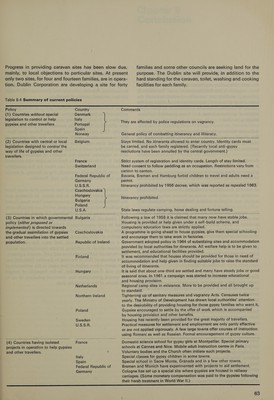
![families and some other councils are seeking land for the purpose. The Dublin site will provide, in addition to the hard standing for the caravan, toilet, washing and cooking facilities for each family. Policy (1) Countries without special legislation to control or help gypsies and other travellers (2) Countries with central or local legislation designed to contro/ the way of life of gypsies and other travellers. (3) Countries in which governmental policy (either proposed or implemented) is directed towards the gradual assimilation of gypsies and other travellers into the settled population. (4) Countries having isolated projects in operation to help gypsies and other travellers. Country Denmark Italy Portugal Spain f Norway Belgium France Switzerland Federal Republic of Germany U.S.S.R. Czechoslovakia Hungary ] Bulgaria Poland ‘i U.S.A. Bulgaria Czechoslovakia Republic of Ireland Finland Hungary Netherlands Northern Ireland Poland Sweden US och: France Italy Spain Federal Republic of Germany Comments They are affected by police regulations on vagrancy. General policy of combatting itinerancy and illiteracy. Stays limited. No itinerants allowed to enter country. Identity cards must be carried, and each family registered. (Recently local anti-gypsy resolutions have been annulled by the central government.) Strict system of registration and identity cards. Length of stay limited. Need consent to follow peddling as an occupation. Restrictions vary from canton to canton. Bavaria, Bremen and Hamburg forbid children to travel and adults need a permit. Itinerancy prohibited by 1956 decree, which was reported as repealed 1963. Itinerancy prohibited. State laws regulate camping, horse dealing and fortune telling. Following a law of 1958 it is claimed that many now have stable jobs. Housing is provided or help given under a self-build scheme, and compulsory education laws are strictly applied. A programme is going ahead to house gypsies, give them special schooling and encourage them to take work in factories. Government adopted policy in 1964 of subsidizing sites and accommodation provided by local authorities for itinerants. All welfare help is to be given to settlement, and educational facilities provided. It was recommended that houses should be provided for those in need of accommodation and help given in finding suitable jobs to raise the standard of living of itinerants. It is said that about one-third are settled and many have steady jobs or good seasonal ones. In 1961 a campaign was started to increase educational and housing provision. Regional camp sites in existence. More to be provided and all brought up to standard. Tightening up of sanitary measures and vagrancy Acts. Censuses twice yearly. The Ministry of Development has drawn local authorities’ attention to the desirability of providing housing for those gypsy families who want it. Gypsies encouraged to settle by the offer of work which is accompanied by housing provision and other benefits. Housing has recently been provided for the great majority of travellers. Practical measures for settlement and employment are only partly effective or are not applied vigorously. A few large towns offer courses of instruction using Romani as well as Russian. Formal encouragement of gypsy culture. Domestic science school for gypsy girls at Montpellier. Special primary schools at Cannes and Nice. Mobile adult instruction centre in Paris. Voluntary bodies and the Church often initiate such projects. Special classes for gypsy children in some towns. Special school in Sacre Monte, Granada and in a few other towns. Bremen and Munich have experimented with projects to aid settlement. Cologne has set up a special site where gypsies are housed in railway carriages. (Some monetary compensation was paid to the gypsies following their harsh treatment in World War II.)](https://iiif.wellcomecollection.org/image/b32173088_0093.jp2/full/800%2C/0/default.jpg)