Preparation of acid phenylic salts of dibasic acids / by S.B. Schryver.
- Samuel Barnett Schryver
- Date:
- [1899.]
Licence: Public Domain Mark
Credit: Preparation of acid phenylic salts of dibasic acids / by S.B. Schryver. Source: Wellcome Collection.
6/14 page 664
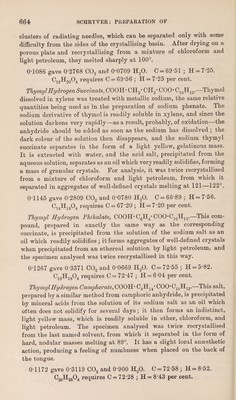
![clusters of radiating needles, which can be separated only with some difficulty from the sides of the crystallising basin. After drying on a porous plate and recrystallising from a mixture of chloroform and light petroleum, they melted sharply at 100°. 0-1086 gave 0-2768 C02 and 0-0709 H20. C = 69-51 ; H = 7-25. C16H20O4 requires C = 69*56 ; H = 7’25 per cent. Thymyl Hydrogen Succinate, COOH* CH2* CH2* COO* C10H13.—Thymol dissolved in xylene was treated with metallic sodium, the same relative quantities being used as in the preparation of sodium phenate. The sodium derivative of thymol is readily soluble in xylene, and since the solution darkens very rapidly—as a result, probably, of oxidation—the anhydride should be added as soon as the sodium has dissolved ; the dark colour of the solution then disappears, and the sodium thymyl succinate separates in the form of a light yellow, gelatinous mass. It is extracted with water, and the acid salt, precipitated from the aqueous solution, separates as an oil which very readily solidifies, forming a mass of granular crystals. For analysis, it was twice recrystallised from a mixture of chloroform and light petroleum, from which it separated in aggregates of well-defined crystals melting at 121—122°. 0*1145 gave 0-2809 C09 and 00780 H20. C = 66-89 ; H = 7'56. CuH1804 requires 0 = 67*20; H = 7*20 per cent. Thymyl Hydrogen Phthalate, COOH* C6H4*COO*C]0H13.—This com¬ pound, prepared in exactly the same way as the corresponding succinate, is precipitated from the solution of the sodium salt as an oil which readily solidifies ; it forms aggregates of well-defined crystals when precipitated from an ethereal solution by light petroleum, and the specimen analysed was twice recrystallised in this way. 0-1267 gave 0-3371 C02 and 0-0669 H20. C = 72-55 ; H = 5*82. Ci8Hi804 requires 0 = 72*47 ; H = 6’04 per cent. Thymyl Hydrogen Camphor ate, COOH* C8H14* COO*C10H13.—This salt, prepared by a similar method from camphoric anhydride, is precipitated by mineral acids from the solution of its sodium salt as an oil which often does not solidify for several days; it then forms an indistinct, light yellow mass, which is readily soluble in ether, chloroform, and light petroleum. The specimen analysed was twice recrystallised from the last named solvent, from which it separated in the lorrn of hard, nodular masses melting at 89°. It has a slight local anaesthetic action, producing a feeling of numbness when placed on the back of the tongue. 0*1172 gave 0*3119 C02 and 0-900 H20. 0 = 72*58; H = 8*52. C20H28O4 requires 0 = 72*28 ; 11 = 8*43 per cent.](https://iiif.wellcomecollection.org/image/b30597134_0006.jp2/full/800%2C/0/default.jpg)