On the skull and portraits of George Buchanan / by Karl Pearson.
- Karl Pearson
- Date:
- 1926
Licence: Public Domain Mark
Credit: On the skull and portraits of George Buchanan / by Karl Pearson. Source: Wellcome Collection.
15/56 page 7
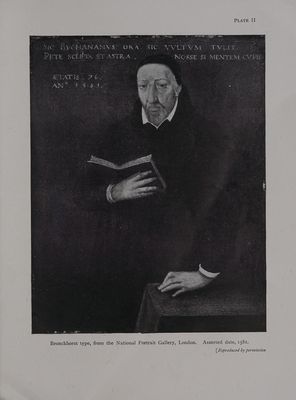
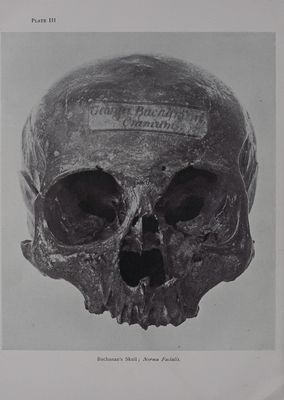
![of Henderson’s account, that the skull was found in Adamson’s study after his death, inscribed with the name of Buchanan, doubtless corresponds to the truth. And if so, Adamson would hardly have obtained the skull without the assistance of the sexton, or kept it without a fair amount of certainty that it came from George Buchanan’s tomb. It is noteworthy that while John Adamson says there was no tomb- stone to Buchanan’s grave, we read in 1701 of the existence of such a stone: “At Edinburgh, the 3rd day of December 1701, the same day the council being informed, that the through stone [tombstone] of the deceast George Buchanan lyes sunk under the ground of the Greyfriars: therefore they appoint the chamberlain to raise the same, and clear the inscription thereon ; so that the same may be legible.” If we could ascertain at what date that stone was erected, we should have an upper limit to the date when the Principal of the University robbed the Greyfriars, for there was clearly no stone when he wrote his verses. I have not succeeded in finding any real work done on the skull in relation to the portraits. Mr William Carruthers in the Scottzsh Review for 25th October 1906 dismissed the skull, stating that it could not be that of George Buchanan, because it was not like the portrait in the National Portrait Gallery in London. The question seems to be: Is it like any other portrait? If it is, it would only show that the National Portrait Gallery picture is not a truthful representation of Buchanan. Sir William Hamilton is said to have tested Buchanan’s portraits against the skull about 1835 by measurement and found that omly the Chouet woodcut (see Plate I, left) fulfilled his tests. In other words, he appears to have rejected the two portraits in the Senate Hall of his own University, which are of the National Gallery type.. Speaking of the Chouet wood-engraving and its reproduction by Freiherus, Hamilton writes: “The head in both is thoroughly Scottish in character with a long and well-formed nose, well-defined cheek bones and a long upper lip as in the skull.” Now these three characters are all present in the National Portrait Gallery type (see Plate II), but appear to be quite absent in the skull. I am not clear what a head “ Scottish in character” may be. It is not possible craniometrically to distinguish really significant differences between the Lowland Scottish measured by Turner and the seventeenth century Londoners measured in my own Laboratory. Recently some aro](https://iiif.wellcomecollection.org/image/b3342844x_0015.jp2/full/800%2C/0/default.jpg)


 No text description is available for this image
 No text description is available for this image
 No text description is available for this image