Licence: Public Domain Mark
Credit: A dictionary of medical science / by Robley Dunglison .. Source: Wellcome Collection.
Provider: This material has been provided by the Francis A. Countway Library of Medicine, through the Medical Heritage Library. The original may be consulted at the Francis A. Countway Library of Medicine, Harvard Medical School.
115/1338 page 95
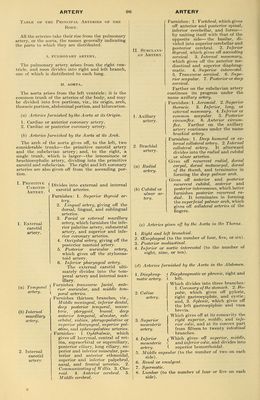
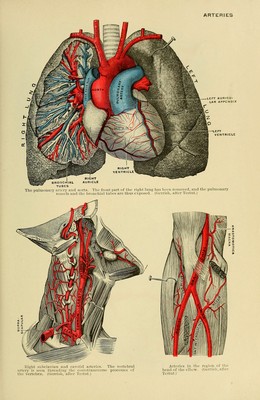
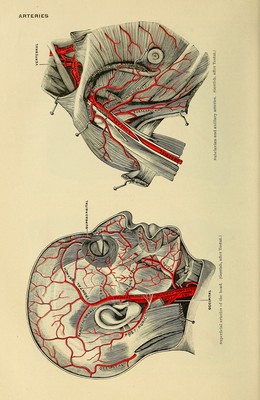
![Arte'rial. Belonging to an artery. A. blood, red blood, so called because contained in arteries; the pulmonary veins also contain red blood, hence they have been called arterial veins. A. cone, infundib- ulum of the heart, see Conus arteriosus. A. con- stitution, plethora arteriosa. A. duct, portion ci the pulmonary artery terminating in the aorta in the fcetus; when obliterated after birth it is called arterial ligament, ligamentum arteriosum. A. sys'tem includes all the arteries from the origin of the aorta at the heart to the termination in the capillaries; see Vascular system. A. veins, the pul- monary veins, because they contain red or arterial blood. Arterializa'tion of the blood. Transformation of venous into arterial blood; hsematosis. Arteriarc'tia. Arteriostenosis. Arten'asis. Degeneration of an artery. Arteriec'tasis (arteria + ektasis. dilatation). Aneu- rysm. Arteriecto 'pia (arteria + ektopos, out of place). Dis- location or unusual location of an artery. Arterieurys'ma Aneurysm. Arterii'tis. Arteritis. Arterin'. Coloring-matter of arterial blood. Arte'riocap'illary. Relating to an artery or ar- teries and the capillary vessels, as arteriocapillnry fibrosis, fibroid degeneration of these vessels, seen sometimes in Bright's disease. Arteriochal'asis (chalasis, relaxation). Atonic con- dition of the arteries. Arte'riococcyg'eal gland. Glomerulus arteriococ- cygeus; Luschka's gland. See Coccygeal gland. Arterioconstric'tor. An instrument used to com- press an artery, being a blunt hook to be passed round the vessel and capable of being tightened up by a screw. Arteriodial'ysis {arteria + dialysis, dissolution). False aneurysm. Arteriodias'tasis {diastasis, sejiaration). Retrac- tion of the ends of a divided artery. Aiteriodiplopies'mus (diploox, double, piesmos, pressure). Method of producing coagulation in an artery between two points on which pressure is made. Arte'riofibro'sis. Fibroid degeneration of the arteries, usually associated with that of the capil- laries, resulting in a narrowing of their lumen. Arte'riogram. Sphj gmographic tracing of an artery. Arteriography (arteria + graphe, a description). Description of arteries; study of pulse curves. Arte'rioid. Resembling an artery. Arterio'la (dim. of arteria) or Arte'riole. A mi- nute artery; one of the terminal divisions of the arterial system which itself subdivides into cap- illar] es. Arterio'lse (pi. of arteriola). A. rec'tae, minute blood-vessels in the medullary pyramids of the kidney. Arte'riolith (lithos, stone). Arterial calculus; con- cretion in an arterv. Arteriol'ogy (arteria + logos, discourse). Treatise on arteries; description of arteries. Arteriomala'cia or Arteriomalaco'sis (malakia, softening). Softening of the coats of an arterv. Arteriom'eter (arteria + matron, measure). An in- strument recording the varying calibre of an artery during; its pulsations. The use of such instrument is called arteriom,'etry. Arteriop'athy (-pathos, disease). Disease of an artery. Arterioperis'sia (perissos. extraordinary). Ex- cessive development of arteries or of arterial tissue. Arteriophlebot'omy (arteria+ phleps, a vein, tome, incision). Bloodletting practised on the skin or mucous membranes by means of leeches, scarifica- tions, or wet cupping. Arteriopitu'itous. Term applied to vessels creep- ing along pituitous membrane of the nostrils. Arteriopla'nia (arteria + planao, to wander), hx- tension or unnatural location of an artery. Arteriorrha'gia. Hemorrhage from a ruptured artery. Arteriorrhex'is (rhexis, rupture;. Rupture of an artery. Arteriosclerosis (arteria + skieros, hard;. Increase of connective tissue leading to thickening of the walls of an artery; induration, especially of the inner coat. Arteriosclerot'ic. Relating to or affected with arteriosclerosis. Arterios'itas or Arterios'ity. Condition of the blood in which it preserves in the veins an arterial character; opposite to venositas. A. san'guinis, predominance of arterial blood. Arteriosteno'sis (stenos, contracted). Contraction or obliteration of an artery. Arteriosteo'sis or Arteriostogen'esis (arteria + os- teon, bone, genesis, formation). Early stage of ossi- fication of an artery. Arteriostrep'sis (arteria + strepsis, twisting). Tor- sion of artery to obliterate its calibre. Arterio'sus. Arterial. Arteriothlim'ma (thlipsis, pressure or friction). Injury to an artery from pressure. Arte'riotome (arteria + tome, incision). Knife for dissection or operation on arteries. Arteriot'omy. Dissection of an artery; open- ing an artery to draw blood from it. See Blood- letting. Arte'riove'nous. Relating to an artery and vein, as arteriovenous aneurysm or aneurysm of an artery opening into a vein. Arteriover'sion <'arteria + verto, to turn). A method of checking hemorrhage from an artery by evert- ing or turning inside out the divided end of the vessel. Arteriover'ter. An instrument for use in arterio- version. Arteriozete'sis (arteria + zeteo, to explore). Direct examination of an artery by exposing it to view. Arteri'tis or Arterii'tis. Inflammation of an artery. Inflammation of the inner coat of an artery is termed endoarteritis or endarteritis; of the outer, exoarteritis or exarteritis. A. defor'mans, inflammation of an artery due to atheromatous changes in its walls. A. hyperplas'tica, inflammation of an artery with new formation of connective tissue. A. oblit'erans, in- flammation of an artery leading to obliteration of its calibre by increase of connective tissue. Ar'tery (Gr., arteria, of uncertain derivation, possibly from aer, air, tereo, to preserve, as the ancients believed that arteries contained air. This belief probably arose from the fact that the arteries are commonly found empty after death). Arteries are vessels arising from the two ventricles of the heart and having valves only at their origin. They are cylindrical, firm, and elastic canals, of yellowish- white color, little dilatable, easily lacerable. They have usually been described as formed of three coats: 1. External laminated or areolar membrane, tunica externa or adventitia, or cellularis, vagina cellularis, of dense and close character. 2. Middle coat, tunica media or elastica, composed of fibres of elastic tissue and of smooth muscular fibres, and eminently elastic. 3. Inner or endothelial coat, tunica intima or glabra. thin, diaphanous, reddish, and polished, composed of pavement epithelium, delicate connective tissue, and elastic fibres, perforated so as to entitle it to the name of fenestrated membrane; these coats are also called adventitia, media, and intima, respec- tively, without further qualification, the word tunica being understood. Arteries carry blood from the heart to all parts of the system; but they do not all convey arterial blood, for the pulmonary artery conveys venous blood to the lungs, there to be converted into arterial, while the pulmonary veins convey arterial blood back to the heart.](https://iiif.wellcomecollection.org/image/b2117460x_0115.jp2/full/800%2C/0/default.jpg)
 No text description is available for this image
 No text description is available for this image
 No text description is available for this image