A dictionary of medical science : containing a concise explanation of the various subjects and terms of anatomy, physiology, pathology, hygiene, therapeutics, medical chemistry, pharmacology, pharmacy, surgery, obstetrics, medical jurisprudence, and dentistry, notices of climate, and of mineral waters, formulae for officinal, empirical and dietetic preparations : with the accentuation and etymology of the terms, and the French and other synonyms / by Robley Dunglison.
- Robley Dunglison
- Date:
- 1874
Licence: Public Domain Mark
Credit: A dictionary of medical science : containing a concise explanation of the various subjects and terms of anatomy, physiology, pathology, hygiene, therapeutics, medical chemistry, pharmacology, pharmacy, surgery, obstetrics, medical jurisprudence, and dentistry, notices of climate, and of mineral waters, formulae for officinal, empirical and dietetic preparations : with the accentuation and etymology of the terms, and the French and other synonyms / by Robley Dunglison. Source: Wellcome Collection.
Provider: This material has been provided by University of Bristol Library. The original may be consulted at University of Bristol Library.
46/1183 page 34
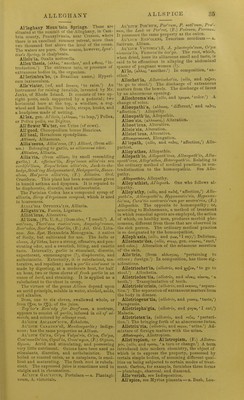
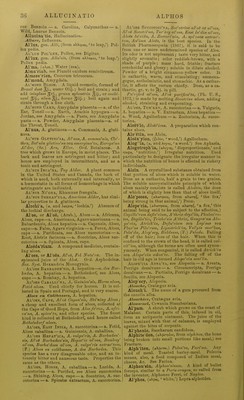
![Dr. Prout has four great cliisscs — tbe aqueoun, anccharine, olcayinoiis, and ulbuiinHOKa. Dr. Po- reira, twelve — aqueous, viucilngiuoua or yidiimy, Baccharine, amylaceous, liguetnu, ]}ectinaceous, acidulous, alcoholic, oily or fatty, proti:inaceoua, gelatinous, and saline. Licbig divides them into two classes — the nituogenized or plastic ele- ments OP NUTiuTiON, flesh formers, in which he comprises vegetable fibrin, vegetable albumen, vege- table casein, flesh and blood; and the non-nitro- GENIZED or ELEMENTS OP RESPIRATION, Or OF CALORIFICATION, heat givers, in which he com- prises fat, starch, gum, cane sugar, grape sugar, sugar of milk, pectin, baasorin, wine, beer, and spirits. The former alone, in his view, are in- scrvient to the nutrition of organized tissue: the latter are burnt in respiration, and furnish heat. The following simple arrangement is, perhaps, as little objectionable as any : <■ Fibrinous (Glutinous?) 1. Nilrogenized Aliments, < Albuminous. (Caseiiious, Gelatinous, j Amylaceous. 2. I^onrtiitrogenized AKments,< Saccharine. I, Oleaginous. 3. Inorganic. The second division might be still further sim- plified, inasmuch as amylaceous aliments are con- vertible into sugar during the digestive process ; and from both oleaginous matter may be formed. Aliments are at times divided into the substan- tive, and the adjective or accessory; the former comprising all the nutritive substances, which are used as food; the latter condiments. See Condi- ment. Aliment'al, Nutrimental. Aliment'ary, Nutrimental — a. Canal, Canal, alimentary—a. Duct, Canal, alimentary—a. Tube, Canal, alimentary. Alimenta'tion, Alimenta'tio. The act or power of nourishing. Alimenta'tion, Io'dic. A term applied to the giving of iodine internally in combination with food, as bread and olher farinaceous substances. AJimcHteuoD, Nutrimental. Aliraent'um, Aliment, Pabulum. Al'imos, Glycyrrhiza. Alinde'sis, (aAiv^iymf, from aXtjiioiiai, 'to be turned about.') A species of exercise, which con- sisted in rolling in the dust, after having been anointed with oil. Alipas'nos, Alipw'nwn, Alipan'tns, (a, and 'to be fat.') An epithet formerly given to every external remedy, devoid of fat or mois- ture ; such as powders. AUpan'tos, AlipsBnos. Alip'ta, Alip'tes, (aXscTrrrji, from aXeutxa, ' I anoint') He who anointed the Athleta3 after bathing. The place where this was done was called Alipte'rium. Alipte'rium, (aXsnrrripiov,) see Alipta. Alip'tica. The part of ancient medicine, ■which treated of inunction as a means of pre- aerving health. AlLiler Itlanc, Crataegus aria. Alis'ma, gen. Alis'matis, ([Celt.] from alis, 'wat^r.')—a. Plantago, Arnica montana—a. Gra- minifolia, A. plantago — a. Lanceolata, A. plan- tago. Alis'ma Planta'go, {aXutfia,) Alis'ma, A. lan- ceola'ta seu graminifo'lia, Planta'go aquat'ica, Wa'ter Plan'tain, (F.) Plantain d'Eaii. Ord. Alismaceaj. Sex. Syst. Hexandria Polygynia. The fresh root is acrid, and the dried leaves will vesicate. The leaves have been proposed as sub- stitutes for Uva Ursi. Alitu'ra, (alere, 'to nourish,') Nutrition. Al'kale, O'leun GaUi'nre. An ancient phar- maceutical name for pullets' fat. Alkales'cence, Alcalescence. Al'kali, sec Aleali—a. Ammoniacum caus- ticuni, Ammonia — a. Ammoniacum spirituosum, Spiritus amuiouiaj — a. Causticum, Aleali caus- ticuin — a. Mineralo nitratum, Soda, nitrate of— a. Minerale phosphoratum. Soda, phosphate of— a. Minerale salinum. Soda, muriate of—a. Vege- tabile cum aceto, Potassae acctas — a. Vegetabilo fixum causticum, Potassa fusa—a. Vegetable, Potash—a. Volatile, Ammonia—a. Volatile caus- ticum, Ammonia—a. Volatile, concrete, Ammoniaj carbonas — a. Volatile, mild, Ammonia} carbonas —a. Volatile nitratum, Ammonia; nitras—a. Vola- tile tartarizatum, Ammoniic tartras — a. Volatile vitriolatum. Ammonia) sulphas. Al'kaligene, Azote. Al'kaline, Alcaline. Alkalinity, see Alcalescence. Alkalinu'ria, Alcalinu'ria, (from alkali, and ovpoi/,' urine.') A condition of the urine in which it is alkaline. Arkaloid, Alcaloid. Al'kanet, Bas'tard, Lithospermum oflBcinale— a. Dyer's, Anchusa tinctoria—a. Garden, Anchusa officinalis — a. Officinal, Anchusa officinalis. Al'kar, Medicament. Alkeken'gi, Physalis. Alhehenr/ine Silic6e, see Pills, Laville's. Alker'mes, Confec'tio Alker'mes, Alcher'niea. A celebrated stimulant electuary, composed of a multitude of substances; so called from the grains of kcrmes contained in it. Also, kermes. Alker'va, see Ricinus communis. Al'kitran, Cedria. Arkol, Alcohol. Al'kool, Alcohol. Alkym'istre, Alchymist. Al'la, Cerevisia. Allaitenient, (from allaitcr,) Lactation, Allalter, (F.) {al, and lait, 'milk,' (L.) adlac- tare.) To suckle. AUaman'da, A. Oathar'tioa seu grandiflo'ra, Ore'lia grandiflo'ra, Gal'aripa, Eehi'nus scan'- dena, Apoeynum scrin'dena, (after Dr. Allamand, a Leyden naturalist.) A shrub, native of Guiana, the infusion of whose leaves is said by Linnaus to be useful in Colica Pictonum. Allaman'da Cathar'tica, AUamanda — a. Grandiflo'ra, AUamanda. Allanto'des, Allantois. AUan'toio Aoid, Ac{dum allanto'icnm, Am^- nic or Amniot'ic acid. A peculiar acid found in the liquor of the allantois of the cow. Allan'toid Ves'icle, Allantois. AUantoi'des, Allantois. Allan'toiS, AllantnVdea, Allanto'des, Membra'- na urina'ria, 31. seu Tu'nica Farcimiua'lis, M. Tntestina'lis, the Allan'toid Ves'icle, {aXKa^, gen. aWavTOi, 'a sausage,' and £i(!of, 'shape.') A sort of elongated bladder, between the chorion and amnion of the foetus, which is thrown out from the caudal extremity of the embryo, and commu- nicates with the bladder by the urachus. It is very apparent in quadrupeds, but not in the hu- man species. As the allantois is developed, its walls become very vascular, and contain the rami- fications of what become the umbilical artery and vein, which, by the elongation of the allantois, are brought through the villi of the chorion into indirect communication with the vessels of the mother. AllantotOX'icum, (aXXa?, gen. aXAarrOj, a sausage,' and m^iMv,' a poison.') Sausage poison, (G.) Wurstgift. The Germans have given this name to a poison developed in sausages formed of blood and liver. See Trichina spi- ralis. T . Al'larton's Operation of Lithot'omy, see Li- thotomy. Allec'tuary, Electuarium.](https://iiif.wellcomecollection.org/image/b21443063_0046.jp2/full/800%2C/0/default.jpg)
 No text description is available for this image
 No text description is available for this image
 No text description is available for this image