Dr Airy's report to the local government board on diphtheria and fever in the Grays sub-district of the Orsett registration district in 1889.
- Airy, Hubert.
- Date:
- 1890
Licence: Public Domain Mark
Credit: Dr Airy's report to the local government board on diphtheria and fever in the Grays sub-district of the Orsett registration district in 1889. Source: Wellcome Collection.
Provider: This material has been provided by London School of Hygiene & Tropical Medicine Library & Archives Service. The original may be consulted at London School of Hygiene & Tropical Medicine Library & Archives Service.
6/8 page 6
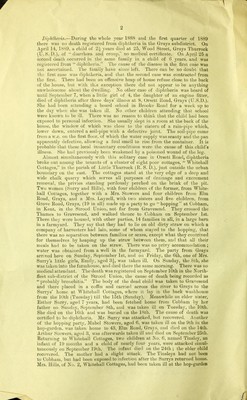
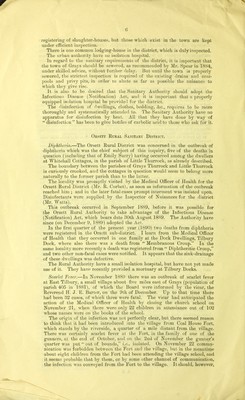
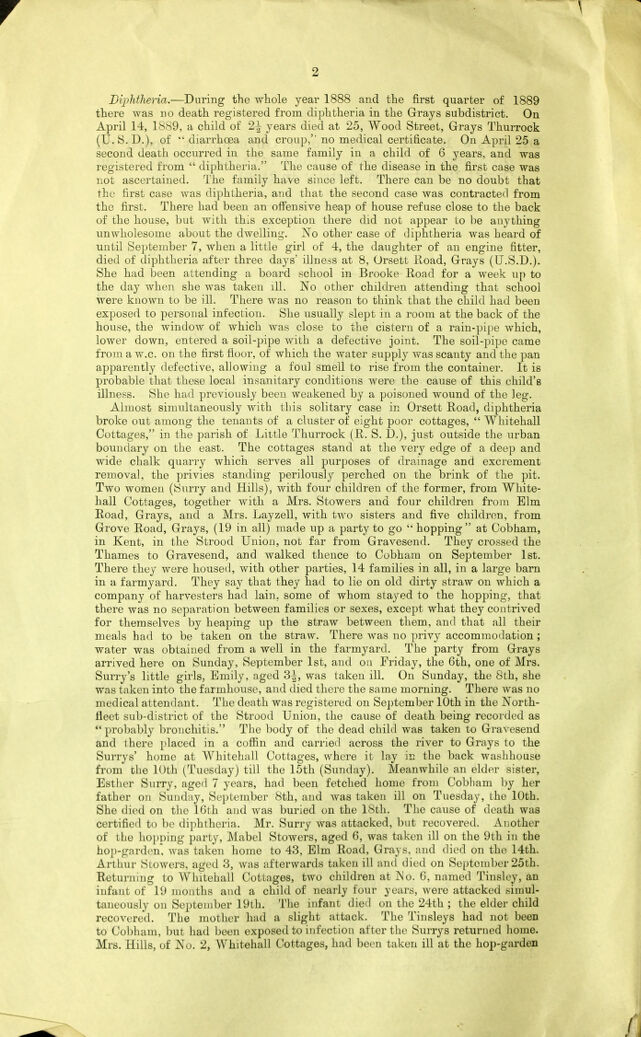
![registering- of slaughter-houses, but those which exist in the town are kept under efl&cient inspection. There is one common lodging-house in the district, which is duly inspected. The urban authority have no isolation hospital. In regard to the sanitary requirements of the district, it is important that the town of Grays should be sewered, as recommended by Mr. Spear in 1834, under skilled advice, without further delay. But until the town is properly sewered, the strictest inspection is required of the existing drains and cess- pools and privy pits, in order to abate as far as possible the nuisance to which they give rise. It is also to be desired that the Sanitary Authority should adopt the Infectious Disease (Notification) Act, and it is important that a properly equipped isolation hospital be provided for the district. The disinfection of dwellings, clothes, bedding, &c., requires to be more thoroughly and systematically attended to. The Sanitary Authority have no apparatus for disinfection by heat. All that they have done by way of disinfection has been to give bottles of carbolic acid to those who ask for it. • Orsett Rural Sanitary Distbict. Diphtheria.—The Orsett Rural District was concerned in the outbreak of diphtheria which was the chief subject of this inquiry, five of the deaths in question (including that of Emily Surry) having occurred among the dwellers at Whitehall Cottages, in the parish of Little Thurrock, as already described. The boundary between the parishes of Grays Thurrock and Little Thurrock is curiously crooked, and the cottages in question would seem to belong more naturally to the former parish than to the latter. The locality was prom]3tly visited by the Medical Officer of Health for the Orsett Rural District (Mr. R. Corbet), as soon as information of the outbreak reached him ; and in the later fatal cases prompt interment was insisted upon. Disinfectants were supplied by the Inspector of Nuisances for the district (Mr. Watts). This outbreak occurred in September 1889, before it was possible for the Orsett Rural Authority to take advantage of the Infectious Disease (Notification) Act, which bears date 30th August 1889. The Authority have since (on December 9, 1889) adopted the Act. In the first quarter of tbe present year (1890) two deaths from diphtheria were registered in the Orsett sub-district. I learn from the Medical Officer of Health that they occurred in one family at the Dock Dwellings, Tilbury Dock, where also there was a death from Membranous Croup. In the same locality more recently a death was registered from Diphtheritic Croup, and two other non-fatal cases were notified. It appears that the sink-drainage of these dwellings was defective. The Rural Authority have a small isolation hospital, but have not yet made use of it. They have recently provided a mortuary at Tilbury Docks. Scarlet Fever.—In November 1889 there was an outbreak of scarlet fever at East Tilbury, a small village about five miles east of Grays (population of parish 405 in 1881), of which the Board were informed by the vicar, the Reverend H. J. E. Barter, on the 9th of December. Up to that time there had been 82 cases, of which three were fatal. The vicar had anticipated the action of the Medical Officer of Health by closing the church school on November 21, when there were only 22 children in attendance out of 102 whose names were on the books of the school. The origin of the infection was not perfectly clear, but there seemed reason to think that it had been introduced into the village from Coal House Fort, which stands by the riverside, a quarter of a mile distant from the village. There was certainly scarlet fever at the Fort, in the family of one of the gunners, at the end of October, and on the 2nd of November the gunner's quarter was put out of bounds, i.e., isolated. On November 22 commu- nication was forbidden l)etweeu the Fort and the village, but in the meantime about eight children from the Fort had been attending the village school, and it seems })robable that by them, or by some other channel of communication, the infection was conveyed from the Fort to the village. It should, however,](https://iiif.wellcomecollection.org/image/b24398196_0006.jp2/full/800%2C/0/default.jpg)