The year book of daily recreation and information concerning remarkable men and manners, times and seasons, solemnities and merry-makings, antiquities and novelties on the plan of the 'Every-day book and table book.' / By William Hone.
- William Hone
- Date:
- 1838
Licence: Public Domain Mark
Credit: The year book of daily recreation and information concerning remarkable men and manners, times and seasons, solemnities and merry-makings, antiquities and novelties on the plan of the 'Every-day book and table book.' / By William Hone. Source: Wellcome Collection.
35/842 page 46
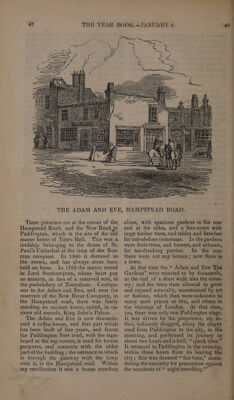
![There are that three nightes onely do perfourme this foolish geare, To this intent, aad thinke themselues in safetie all the yeare* It appears that in the reign of Alfred a law was made relative to holidays which ty to be kept as festivals. - ——— The grand state of the Sovereign, on Twefth day, and the manner of keeping fes- tival at court, in the reign of king Henry VII., are set forth in Le Neve’s MS. called the Royalle Book, “ to the following effect :— As for Twelfth Day the king must go crowned in his royal robes, kirtle, surcoat, his furred hood about his neck, his mantle with a long train, and his cutlas before him; his armills upon his arms, of gold set full of rich stones; and no temporal man to touch it, but the king himself; and the squire for the body must bring it to the king ina fair kercheif, and the king must put them on himself; and he must have his sceptre in his*right hand, and the ball with the -cross in the left hand, and the crown upon his head. And he must offer that day gold, myrrh, and sense; then must the dean of the chapel send unto the arch- oishop of Canterbury by clerk or priest the king’s offering that day; and then must the archbishop give the next benefice that falleth in his gift to the same messenger. And then the king must change his mantle when he goeth to meat, and take off his hood and lay it about his neck, and clasp it before with a great rich ouche; and this must be of the same color that he offered in. And the queen in the same form when she is crowned. The same day that he goeth crowned he ought to go to matins ; to which array belongeth his kirtle, surcoat, tabard, and his furred hood slyved over his head, and rolled about his neck ; and on his head his cap of estate, and his sword before him. At even-song he must goin his kirtle, and surcoat, and hood laid about his shoulders, and clasp the tippet and hood together before his breast with a great rich ouche, and his hat of estate upon his head. As for the Void on the Twelfth night the king and the queen ought to have itin the hall. And as for the wassail, the steward, the treasurer and the controller, * Naogeorgus, Popish Kingdome. + Collier’s Eccles. Hist. shall come for it with their staves in their hands; the king’s sewer and the queen’s having fair towels about their necks, and dishes in their hands, such as the king and the queen shall eat of: the king’s carvers and the queen’s shall come after with chargers or dishes, such as the king or the queen shall eat of, and with towels about their necks. And no man shall bear any thing unless sworn for three months, And the steward, treasurer, comptroller, and marshal of the hall shall ordain for all the hall. And, if it be in the great chamber, then shall the chamberlain and ushers or- dain after the above form; And if there be a Bishop, his own squire, or else the king’s, such as the officers choose to assign, shall serve him: And so of all the other estates, if they be dukes or earls; and so of duchesses and countesses. And then there must come in the ushers of the cham- ber with the pile of cups, the king’s cups and the queen’s, and the bishop’s, with the butlers and wine to the cupboard, and then a squire for the body to bear the cup, and another for the queen’s cup, such as is sworn for hire. The [singers of the chapel] may stand at the one side of the hall: and when the steward cometh in at the hall door, with the wassail, he must cry thrice Wassaile,’&c., and then shall the chapel answer it anon with a good song: and thus in like wise if it please the king to keep the great cham- ber. And then when the king and queen have done they will go in to the chamber. And there belongeth, for the king, two lights with the void, and two lights with the cup; and for the queen as many.* Few are unmoved by either agreeable or painful feelings, on account of ancient customs coming to their notice. We are in general similarly, and more affected Jear to our childhood, which man, more than time, has changed, sometimes really, and always to our thinking, for the worse. In this place it is convenient to arrange for an engraving on the next page, and design for the day under notice, I pre- sume, under favor, upon introducing a brief notice, with an engraving of an old place which I knew when a child, and. which when I see or think of it, associates with some of my fondest remembrances, * Antiq. Rep.](https://iiif.wellcomecollection.org/image/b33291755_0035.jp2/full/800%2C/0/default.jpg)
 No text description is available for this image
 No text description is available for this image
 No text description is available for this image