Copy 1, Volume 1
Essays on subjects connected with the literature, popular superstitions, and history of England in the Middle Ages / By Thomas Wright.
- Thomas Wright
- Date:
- 1846
Licence: Public Domain Mark
Credit: Essays on subjects connected with the literature, popular superstitions, and history of England in the Middle Ages / By Thomas Wright. Source: Wellcome Collection.
160/324 page 144
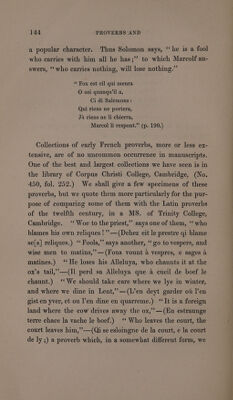
![a popular character. Thus Solomon says, “‘he is a fool who carries with him all he has;” to which Marcolf an- swers, ‘‘ who carries nothing, will lose nothing.” ‘“‘ Fox est cil qui menra O soi quanqu’il a, Ci di Salemons : Qui riens ne portera, Ja riens ne li chierra, Marcol li respont.” (p. 190.) Collections of early French proverbs, more or less ex- tensive, are of no uncommon occurrence in manuscripts. One of the best and largest collections we have seen is in the library of Corpus Christi College, Cambridge, (No. 450, fol. 252.) We shall give a few specimens of these proverbs, but we quote them more particularly for the pur- pose of comparing some of them with the Latin proverbs of the twelfth century, in a MS. of Trinity College, Cambridge. ‘‘ Woe to the priest,”’ says one of them, ‘‘ who blames his own reliques !”?—(Dehez eit le prestre gi blame se[s] reliques.) ‘‘ Fools,” says another, “‘ go to vespers, and wise men to matins,’’>—(Fous vount a vespres, e sages a matines.) ‘‘ He loses his Alleluya, who chaunts it at the ox’s tail,”,—(Il perd sa Alleluya que a cueil de boef le chaunt.) ‘‘ We should take care where we lye in winter, and where we dine in Lent,’’—(L’en deyt garder ot l’en gist en yver, et ou l’en dine en quarreme.) ‘It is a foreign land where the cow drives away the ox,’ —(En estraunge terre chace la vache le boef.) ‘‘ Who leaves the court, the court leaves him,’’—(Qi se esloingne de la court, e la court de ly ;) a proverb which, in a somewhat different form, we](https://iiif.wellcomecollection.org/image/b33097963_0001_0160.jp2/full/800%2C/0/default.jpg)