Copy 1, Volume 1
Essays on subjects connected with the literature, popular superstitions, and history of England in the Middle Ages / By Thomas Wright.
- Thomas Wright
- Date:
- 1846
Licence: Public Domain Mark
Credit: Essays on subjects connected with the literature, popular superstitions, and history of England in the Middle Ages / By Thomas Wright. Source: Wellcome Collection.
34/324 page 18
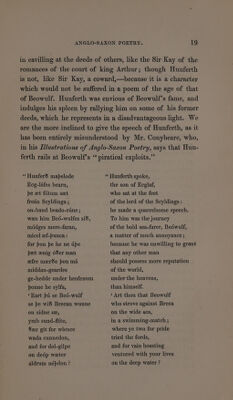
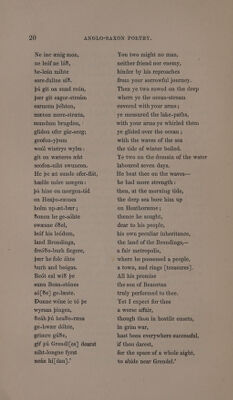
![ac he me habban wile dedre fahne. Gif mec deaé nimed byred blédig weel, byrgean pence : eteS an-genga un-murn-lice ; mearcas mér-hé[f]u; né SG ymb mines ne pearft lices feorme leng sorgian. On-send Hige-lace, gif mec hild nime, beadu-scrada betst pet mine bredst weres, hregla sélest, peet is Hreedlan 1af, Welandes ge-weorc. Ged 4 wyrd swa hid scel.” but he [the Grendel] will have me stained with gore. If death shall take me, bear forth my bloody corpse ; remember to bury me: let the solitary passenger eat un-mournfully : mark my fen-dwelling ; thou needest not about my corpse-feast to care longer. Should the war take me, send to Higelac the best of war-coverings, the most precious of clothing— that which guardeth my breast : it is the legacy of Hreedla, the work of Weland. Fate will always go as it must.” (1. 835.) In another speech, Hrothgar accepts, with many declara- tions of gratitude, the offered aid of Beowulf,—recounts to him the depredations of the fiend who haunted his court, and the unsuccessful attempts which had been made to destroy it, —and finally invites the strangers to join in the festivities of his hall. Our Saxon forefathers seem to have been as much ad- dicted to the making of lengthy speeches as some of their descendants at the present day ; and we have several very fair specimens in the course of the present poem. We are tempted to give an example, though by no means a long one. In the hall of Hrothgar sat a person named Hun- ferth, the son of Ecglaf, envious and jealous, who delighted](https://iiif.wellcomecollection.org/image/b33097963_0001_0034.jp2/full/800%2C/0/default.jpg)